
Language Learning Platforms
Is Preply Worth It? Honest Review of the Language Platform
Breaking down costs, tutor selection, learning experience, and real user feedback to help you decide.
Preply markets itself as a global marketplace connecting language learners with tutors for one-on-one video lessons. The platform hosts over 32,000 tutors across 50+ languages, with English, Spanish, French, German, and Chinese being the most popular. But the real question isn't what Preply claims to offer — it's whether the experience matches the promise for someone trying to learn a language without wasting time or money.
Contents
- 1. What Preply Actually Offers Language Learners
- 2. How the Platform Works in Practice
- 3. Tutor Quality and Selection Process
- 4. Pricing Structure and Hidden Costs
- 5. Preply vs Italki: Direct Comparison
- 6. Learning Experience and Progress Tracking
- 7. Mobile App and Technical Performance
- 8. Business and Corporate Use Cases
- 9. Common Complaints and Limitations
- 10. Who Benefits Most from Preply
- 11. Who Should Look Elsewhere
- 12. Alternatives Worth Considering
- 13. Getting Started Without Waste
- 14. Final Assessment of Preply's Value
I've spent weeks digging through user reviews, testing the platform's workflow, comparing it against direct competitors, and analyzing the pricing model from every angle. The short answer: Preply works well for certain learners and falls short for others. The difference comes down to how you learn, what you're willing to pay, and whether you need structure or flexibility.
This review covers the practical realities — tutor quality variance, the subscription trap, hidden fees, the mobile experience, and how it stacks up against Italki and other alternatives. No marketing fluff. Just what you need to know before handing over a credit card.
What Preply Actually Offers Language Learners
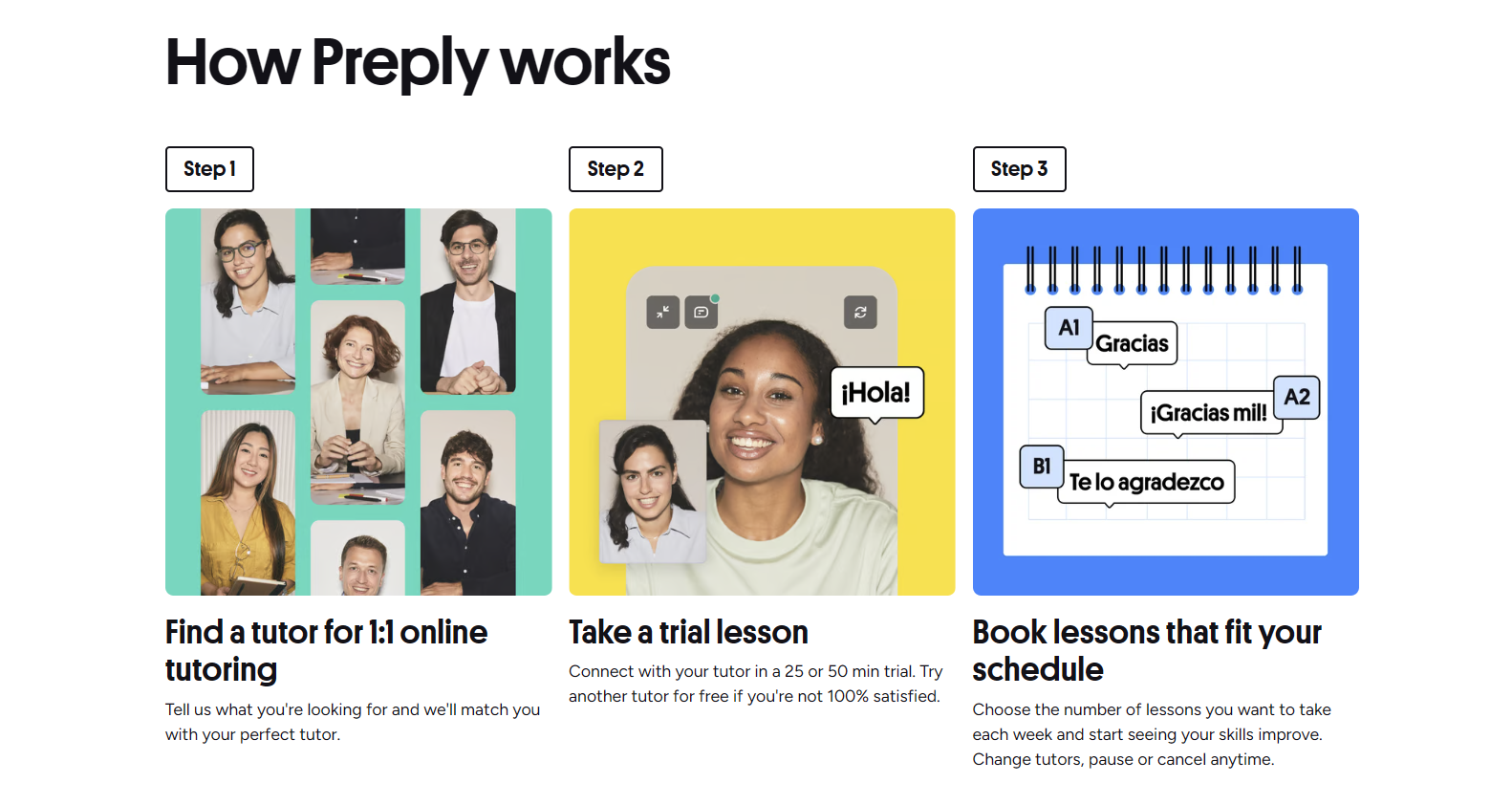
At its core, Preply is a tutor marketplace. You browse profiles, filter by language, price, availability, and specialty — business English, test prep, conversation practice, kids' lessons — then book a trial lesson. Most trials run 25 or 50 minutes at a discounted rate. After that, you buy lesson packages tied to a specific tutor. The platform handles scheduling, video calls, payments, and basic progress tracking.
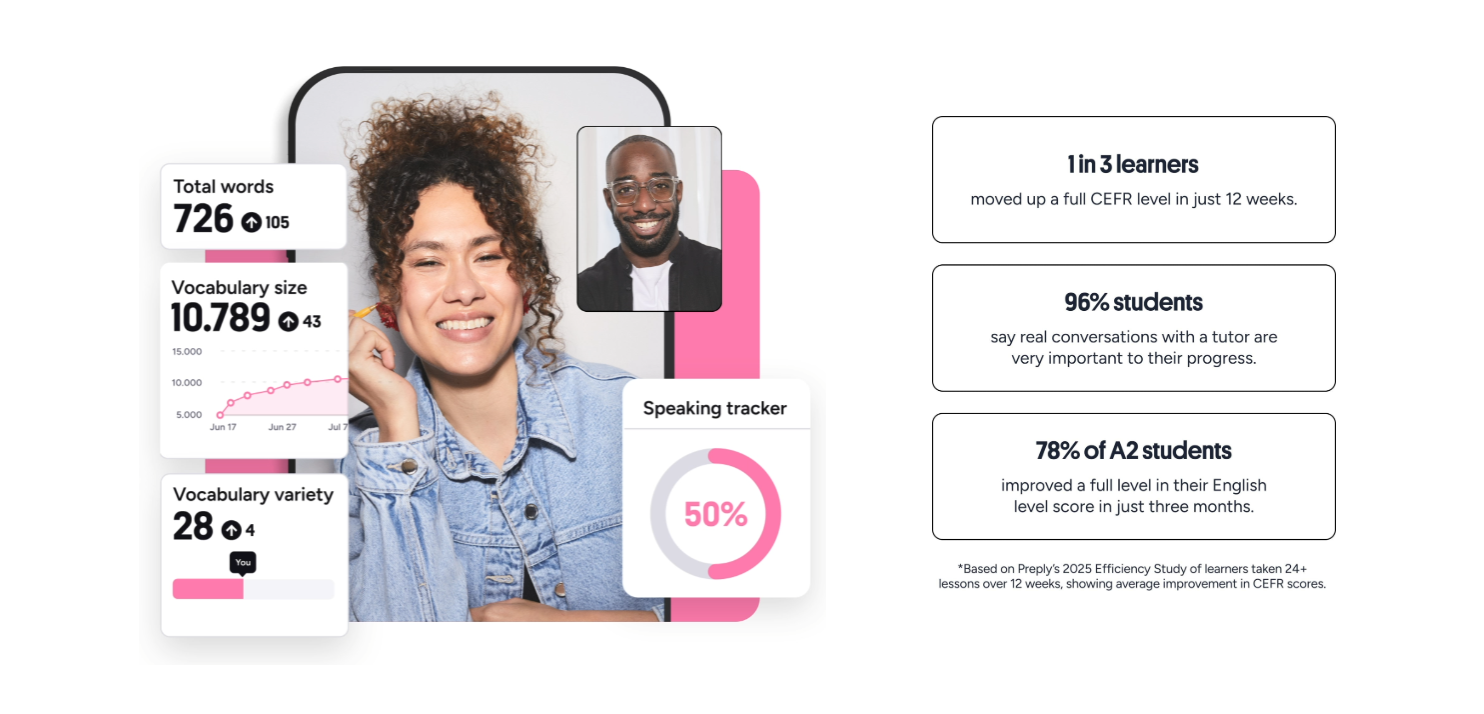
What distinguishes Preply from a simple directory is the integrated classroom. Lessons happen in Preply's own video environment with a shared whiteboard, chat, file sharing, and lesson notes. Tutors can assign homework through the platform. Students see a dashboard with lesson history, upcoming sessions, and a progress graph based on tutor assessments. It's functional, not flashy.
The platform also offers group classes for some languages, a self-study library with exercises, and a placement test for English. These extras are hit or miss. The group classes tend to be small — often just two to four students — which defeats the cost advantage. The self-study material feels like an afterthought compared to dedicated apps like Duolingo or Babbel. The placement test is decent for a rough CEFR estimate but no substitute for a proper assessment.
For businesses, Preply sells team plans with admin dashboards, usage analytics, and centralized billing. That side of the platform operates almost like a separate product — different pricing, different onboarding, different support tier. Individual learners won't touch those features, but they explain why Preply's marketing sometimes feels split between casual learners and corporate HR departments.
How the Platform Works in Practice
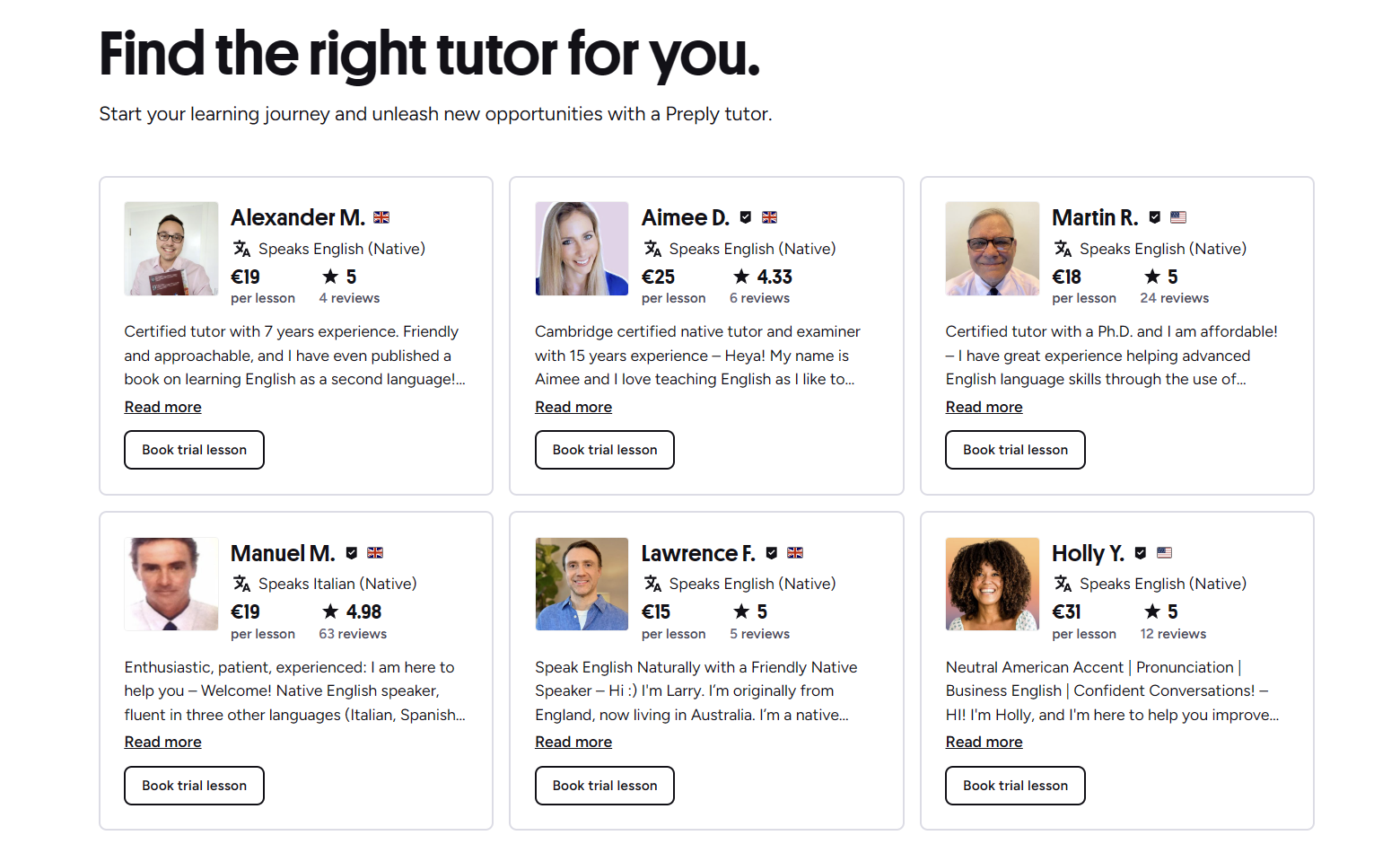
Signing up takes a few minutes. You pick a language, answer a few questions about goals and level, then land on a tutor feed. The filtering system is the first real test. You can sort by price range, tutor nationality, availability timezone, specialties, and rating. Each profile shows hourly rate, number of lessons taught, student count, response time, and a video introduction. Most tutors have 4.8+ ratings, which makes differentiation hard at a glance.
Booking a trial lesson requires selecting a time slot from the tutor's calendar. The calendar shows availability in your local timezone, which helps. You pay for the trial upfront — usually $1 to $5 for 25 minutes, sometimes free during promotions. After the trial, if you want to continue, you must purchase a package: 5, 10, 15, or 20 lessons. The per-lesson price drops slightly with larger packages, but you're locked into that tutor.
Here's where friction appears. If the tutor isn't a fit after three lessons, you can request a tutor change, but Preply's policy requires using remaining lessons with the new tutor at their rate. If the new tutor charges more, you pay the difference. If they charge less, you don't get a refund. This package model creates inertia — many students stay with mediocre tutors rather than lose money switching.
The video classroom loads in the browser — no download required for desktop. It works on Chrome, Firefox, Safari, and Edge. Mobile users need the app (iOS or Android) for lessons; the mobile browser version is limited. Screen sharing, whiteboard, and file upload work reliably most of the time. Occasional audio sync issues appear in reviews, especially on weaker connections. Preply recommends 5 Mbps up/down for stable video.
Tutor Quality and Selection Process
Preply's tutor vetting is lighter than many assume. Tutors create a profile, upload a video intro, set their rate, and pass a basic identity check. There's no mandatory teaching certification, no demo lesson evaluated by Preply staff, and no standardized training. The platform relies on student reviews to surface quality. This means you'll find certified teachers with master's degrees alongside native speakers with no formal training but great conversation skills.
The rating system inflates scores. Most tutors sit between 4.8 and 5.0 after dozens of reviews. A 4.7 rating is actually a warning sign. Read the written reviews — look for mentions of preparation, punctuality, materials, and adaptation to student level. Generic praise like "great teacher!" tells you nothing. Also check the tutor's lesson count. Someone with 500+ lessons has survived the marketplace; someone with 12 might be new or struggling to retain students.
Specialization tags help narrow the field. Tags like "IELTS," "Business English," "Kids," "Beginners," "Conversation," "Grammar" appear on profiles. But these are self-selected. A tutor tagging "IELTS" might have helped one student pass once. Always ask in the trial: "How many IELTS students have you prepared? What materials do you use? Can you show me a sample lesson plan?" The answer reveals more than any tag.
Native vs. non-native tutors spark endless debate. Preply has both. Non-native tutors often charge less and may explain grammar more systematically because they learned it consciously. Native tutors excel at idioms, pronunciation nuances, and cultural context. Neither is universally better. For beginners, a non-native tutor who speaks your language can accelerate early progress. For advanced learners targeting native-like fluency, a native tutor usually makes sense.
The tutor matters more than the platform. A great tutor on a mediocre platform beats a mediocre tutor on a great platform every time.
Pricing Structure and Hidden Costs
Preply tutors set their own hourly rates, typically ranging from $5 to $40+. The platform takes a commission — 18% to 33% depending on the tutor's total lesson count on Preply. New tutors pay the highest commission, which incentivizes them to raise rates or leave. Students don't see the commission; they see the tutor's listed price. That price includes Preply's cut.
Average rates for popular languages: English tutors $10–$30/hour, Spanish $8–$25, French $12–$35, German $15–$40, Chinese $10–$30. Specialized prep (IELTS, TOEFL, business) commands a $5–$15 premium. Kids' tutors often charge more due to specialized materials and patience requirements. These are marketplace averages — outliers exist in both directions.
Scroll horizontally to see all columns
| Language | Budget Range | Mid Range | Premium Range |
|---|---|---|---|
| English | $5–$12 | $12–$22 | $22–$40+ |
| Spanish | $5–$10 | $10–$18 | $18–$35+ |
| French | $8–$15 | $15–$25 | $25–$40+ |
| German | $10–$18 | $18–$30 | $30–$45+ |
| Chinese | $8–$15 | $15–$25 | $25–$40+ |
The subscription model is where Preply gets expensive. You don't pay per lesson after the trial — you prepay for packages. A 10-lesson package at $20/hour means $200 upfront. Preply also offers a monthly subscription (Preply Plus) for $9.99/month that gives 10% off lessons, priority support, and access to group classes. For heavy users, the math works. For casual learners, it's another recurring charge.
Hidden costs catch people off guard. If a tutor raises their rate, your existing package honors the old price until it expires — but the next package costs more. If you cancel a lesson less than 4 hours before start time, you lose the lesson credit. Tutors can also cancel, and while Preply promises a makeup or refund, the process takes days. Currency conversion fees apply if you pay in a non-supported currency. And the 70% discount banner on the homepage? That's for the first package only, usually capped at a low lesson count.
Preply vs Italki: Direct Comparison
Italki is Preply's closest competitor. Both are tutor marketplaces with similar language selections. The differences matter. Italki uses a pay-per-lesson model — no packages required. You buy credits, spend them lesson by lesson, switch tutors freely. Preply's package model locks you in. Italki's commission is a flat 15% for tutors, lower than Preply's tiered 18–33%, which sometimes translates to slightly lower student prices.
Italki's classroom is more basic — video, chat, file sharing, no built-in whiteboard. Many tutors use external tools (Google Docs, Zoom, Miro) which adds friction but offers more flexibility. Preply's integrated classroom keeps everything in one place, which matters for less tech-comfortable learners. Italki also has a community section with free language exchanges, writing corrections, and forums. Preply's community features are minimal.
Scroll horizontally to see all columns
| Feature | Preply | Italki |
|---|---|---|
| Payment model | Prepaid packages per tutor | Pay-per-lesson with credits |
| Tutor commission | 18–33% (tiered) | 15% flat |
| Classroom tools | Integrated whiteboard, notes | Basic video + chat |
| Tutor switching | Allowed with rate adjustment | Free anytime |
| Community features | Minimal | Language exchange, forums |
| Mobile app | Required for mobile lessons | Optional, browser works |
| Trial lessons | Discounted, 25/50 min | Discounted, 30 min standard |
| Business plans | Dedicated enterprise tier | Italki Business (newer) |
Tutor pools overlap significantly. Many tutors teach on both platforms. If you find a tutor you like, check their Italki profile — they may charge less there due to lower commission. But Preply's integrated classroom and progress tracking give it an edge for learners who want structure without managing external tools. Italki suits learners who want maximum flexibility and don't mind piecing together their own workflow.
If you know exactly what you want and just need a tutor, Italki's flexibility wins. If you want the platform to handle scheduling, materials, and progress tracking, Preply earns its premium.
Learning Experience and Progress Tracking
Progress on Preply depends almost entirely on the tutor. The platform provides a framework — lesson notes, homework assignments, a progress graph — but the content is tutor-created. Some tutors follow structured curricula (CEFR-aligned textbooks, custom slide decks, spaced repetition systems). Others wing it with conversation practice. You won't know until the trial.
The progress graph shows tutor-assessed CEFR levels over time. It's a rough visualization, not a standardized test. Tutors update it periodically — some after every lesson, some monthly, some never. Don't treat it as certification. It's a conversation starter: "My graph shows I moved from A2 to B1 in speaking but reading is stuck. What should we focus on?"
Homework functionality exists but varies. Tutors can assign exercises through Preply's library or upload custom files. Students submit, tutors review, feedback appears in the lesson thread. It works for structured learners. For conversation-focused lessons, homework often doesn't exist. The self-study library covers grammar, vocabulary, and reading exercises for English, Spanish, French, German, and a few others. Quality is uneven — some exercises are excellent, others feel auto-generated.
Group classes deserve a separate mention. Preply markets them as affordable alternatives to 1-on-1. In practice, groups are tiny (2–4 students), scheduled at fixed times, and tutor quality varies more than 1-on-1. The dynamic changes — you get less speaking time, more listening. For the price difference (roughly 40–60% of 1-on-1), some learners find value. Others prefer the full attention of private lessons. Try one before committing.
Mobile App and Technical Performance
The mobile app (iOS and Android) is required for lessons on phones and tablets. Desktop users can use the browser. The app handles scheduling, messaging, lesson history, and the video classroom. It's functional but not polished. Common complaints: occasional notification failures, chat sync delays, video freezes on older devices, and battery drain during hour-long lessons. Updates arrive monthly but rarely address core stability.
Offline access is limited. You can review lesson notes and vocabulary lists offline, but the self-study exercises and video classroom require connection. For travelers or commuters with spotty signal, this matters. The app also doesn't support picture-in-picture on iOS, so you can't take notes in another app during a lesson without pausing video.
Technical support responds within 24 hours for paying customers, slower for trial users. Live chat exists but often routes to bots first. Refund requests for technical issues (tutor no-show, platform outage) are usually honored but take 5–10 business days. The platform has 99.5%+ uptime historically — outages are rare but when they happen, lessons get rescheduled, not refunded automatically.
Business and Corporate Use Cases
Preply Business operates as a distinct product. Companies buy seat licenses, get an admin dashboard to assign tutors, track team progress, and manage billing. Tutors for business plans are vetted more strictly — Preply claims they filter for business English certification and corporate experience. Pricing is custom, typically volume-discounted from retail rates.
For individual learners, the business side matters only if your employer pays. Some companies offer Preply as a benefit. If that's you, the experience differs: dedicated account manager, curated tutor shortlist, progress reports sent to HR (opt-out varies by company), and no package lock-in — the company buys hours, you use them across tutors. It's a better deal than retail if your company covers it.
Common Complaints and Limitations
Reading thousands of reviews across Trustpilot, Reddit, App Store, and Google Play reveals consistent patterns. The top complaint: tutor no-shows or last-minute cancellations. Preply's policy penalizes tutors (they lose the lesson fee), but students still lose the time slot. Refunds process automatically but the frustration remains. Some tutors overbook across platforms and cancel the lower-paying lesson.
Second: the subscription auto-renewal. Preply defaults to auto-renew for packages. Many users miss the renewal email, get charged for another 10 lessons, then face a hassle getting a refund if they didn't want to continue. The cancellation flow is buried in settings. Turn off auto-renew immediately after purchasing if you're unsure.
Third: customer support quality varies. Simple issues (refund for tutor no-show) resolve fast. Complex issues (disputes over lesson quality, billing errors, account suspensions) can drag for weeks with copy-paste responses. Preply's support team is outsourced in tiers — frontline agents follow scripts, escalation reaches humans with authority. Persistence pays.
Fourth: the review system discourages honesty. Tutors can see who left negative reviews. Some students report tutors pressuring them to change 3-star reviews to 5 stars. Preply's terms forbid this, but enforcement is reactive. The result: inflated ratings that make tutor selection harder. Always read the 3- and 4-star reviews first — they contain the real signal.
The rating system is broken by design. When tutors can identify reviewers, honest feedback becomes risky. Read between the lines of every 5-star review.
Who Benefits Most from Preply
Preply works best for intermediate learners who need speaking practice and targeted feedback. Beginners often struggle — they need more structure than most tutors provide, and the platform's self-study material isn't sufficient as a primary curriculum. Advanced learners benefit from specialized tutors (legal English, medical Spanish, academic writing) but may find the tutor pool thin for niche needs.
Busy professionals who value scheduling convenience over price like Preply. The calendar integration, automatic reminders, and integrated classroom reduce friction. If you'd pay a premium to avoid coordinating Zoom links, Google Docs, and WhatsApp groups with a tutor, Preply earns its keep. The package model also forces commitment — some learners need that psychological lock-in to show up.
Test prep students (IELTS, TOEFL, DELE, Goethe) do well if they find a specialist tutor. The platform's filtering helps, but verify credentials in the trial. Ask for recent student scores. A tutor who helped someone jump from 6.5 to 7.5 in IELTS writing three months ago is worth more than one with a generic "IELTS" tag and no proof.
Kids' lessons are a growing segment. Preply has a "Kids" filter and tutors with child-specific materials. Parents appreciate the supervised environment — lessons are recorded (with consent), chat is monitored, and tutors pass enhanced background checks. Prices run 20–30% higher than adult lessons. For families wanting native exposure without relocation, it's a viable option.
Who Should Look Elsewhere
Absolute beginners with no language foundation often flounder. They need a structured curriculum, not a conversation partner. Apps like Duolingo, Babbel, or Busuu — or a traditional course — build the base faster and cheaper. Come to Preply after you can hold a basic conversation.
Budget-conscious learners should calculate the annual cost. Two lessons weekly at $15/hour = $1,560/year. At $25/hour = $2,600. Compare that to a community college course ($300–$600/semester), a group class ($200–$400/term), or a self-study app subscription ($80–$200/year). Preply is a premium product. If the price hurts, it's not the right tool yet.
Learners who want complete flexibility between tutors will hate the package model. Italki's credit system or Verbling's pay-per-lesson approach fits better. The friction of switching tutors on Preply is real — financial and administrative. If you like sampling different teaching styles weekly, don't lock yourself in.
People needing accredited certificates for visas, university admission, or professional licensing should know: Preply lessons don't count as formal education. Some tutors provide completion certificates, but they carry no official weight. For immigration or academic purposes, you need recognized exam results (IELTS, TOEFL, DELF, etc.) or accredited course transcripts.
Alternatives Worth Considering
Italki remains the closest alternative — same marketplace model, pay-per-lesson, lower tutor commission, larger community features. Verbling offers similar 1-on-1 with a stricter tutor vetting process (requires teaching credentials) but smaller tutor pool and higher average prices. Cambly focuses on English conversation with native speakers, no booking needed — on-demand 24/7 — but no structured curriculum.
For structured self-study: Babbel (grammar-focused, 14 languages), Busuu (CEFR-aligned, community corrections), Lingoda (live group classes with fixed curriculum, more expensive). For specific languages: Baselang (unlimited Spanish for monthly fee), iTalki (already mentioned), LingQ (input-based with tutor option). Each solves a different problem. Preply solves "I want a specific tutor for 1-on-1 video lessons with integrated tools."
Scroll horizontally to see all columns
| Need | Best Alternative | Why |
|---|---|---|
| Maximum tutor flexibility | Italki | Pay-per-lesson, free switching, lower fees |
| Structured curriculum | Lingoda | Fixed syllabus, group classes, CEFR levels |
| Unlimited Spanish practice | Baselang | Monthly flat rate, unlimited 1-on-1 |
| English conversation on demand | Cambly | No booking, 24/7 native tutors |
| Self-study with community | Busuu | CEFR courses, native corrections |
| Certified teachers only | Verbling | Stricter vetting, higher prices |
Getting Started Without Waste
If you decide to try Preply, follow this sequence to minimize risk. First, define your goal precisely: "I want to pass IELTS writing at 7.0 in three months" beats "I want to improve English." Second, filter tutors by that specialty. Third, watch video intros — they reveal teaching style, accent, energy. Fourth, book trials with 3–4 tutors. Use different time slots to test your own schedule reality.
During trials, ask: "What's your plan for my goal? Show me materials you'd use. How do you track progress? What's your cancellation rate?" Take notes. Compare. Don't buy a package until you've done at least two trials. The $5–$10 spent on extra trials saves hundreds on a wrong package.
After choosing a tutor, start with the smallest package (5 lessons). Turn off auto-renew in settings immediately. Schedule all five lessons upfront — consistency beats intensity. After five lessons, evaluate: Is the tutor prepared? Do you speak 70%+ of the time? Is homework relevant? Is progress visible? If yes, buy a larger package. If no, switch tutors before the next package.
Final Assessment of Preply's Value
Preply is a solid platform with real utility for the right learner. It solves the logistics of finding, booking, and running 1-on-1 language lessons better than cobbling together Zoom, PayPal, and Google Docs. The integrated classroom, progress tracking, and tutor variety create a coherent experience. For intermediate-plus learners who know what they need and can afford $15–$30/hour, it's a reasonable choice.
The problems are structural. The package model creates lock-in that benefits Preply's revenue predictability more than student flexibility. The review system inflates ratings, making tutor selection harder than it should be. The commission structure pushes tutor rates up over time. Support quality is inconsistent. These aren't dealbreakers — they're trade-offs. Every platform makes them differently.
Compared to Italki, Preply charges a convenience premium for its integrated tools. Compared to structured courses, it charges a personalization premium for 1-on-1 attention. Compared to apps, it charges a human interaction premium. Whether those premiums are worth it depends entirely on your learning style, budget, and goals. The platform delivers what it promises — access to tutors. The rest is up to you and the tutor you choose.
Preply doesn't teach you a language. A tutor teaches you a language. Preply just makes finding and paying that tutor less painful. Whether that's worth the markup is your call.
Frequently Asked Questions
How much does Preply cost per month on average?
Most learners spend $100–$300 monthly depending on lesson frequency and tutor rates. Two lessons weekly at $20/hour equals roughly $160/month before any subscription fees.
Can I get a refund if I don't like my tutor?
Preply allows tutor changes but remaining lessons must be used with the new tutor at their rate. Full refunds are rare — typically only for tutor no-shows or platform technical failures.
Is Preply better than Duolingo for learning a language?
They serve different purposes. Duolingo builds vocabulary and grammar foundations through gamified self-study. Preply provides live speaking practice with human feedback. Most serious learners use both.
Do Preply tutors need teaching certificates?
No. Preply requires identity verification but not teaching credentials. Many tutors are certified teachers, but many are native speakers without formal training. Always verify qualifications during trial lessons.
Can I use Preply on my phone without the app?
No. Mobile lessons require the Preply app (iOS or Android). The browser version on mobile doesn't support the video classroom. Desktop users can use Chrome, Firefox, Safari, or Edge without downloads.
What happens if my tutor cancels a lesson?
Preply automatically returns the lesson credit to your package. You can reschedule with the same tutor or request a different tutor. Refunds to your original payment method are possible but take 5–10 business days.
Does Preply offer group classes?
Yes, for select languages. Groups typically have 2–4 students and cost 40–60% of 1-on-1 rates. Quality varies more than private lessons. Try one before committing to a package.
Is the 70% discount on Preply real?
It applies only to your first lesson package, usually capped at 5–10 lessons. After that, you pay the tutor's standard rate. Read the promotion terms carefully — they change frequently.