
Language Learning
Preply English Level Test: Complete Guide to Assessment
Understand the test format, scoring, and how it helps match you with suitable tutors.
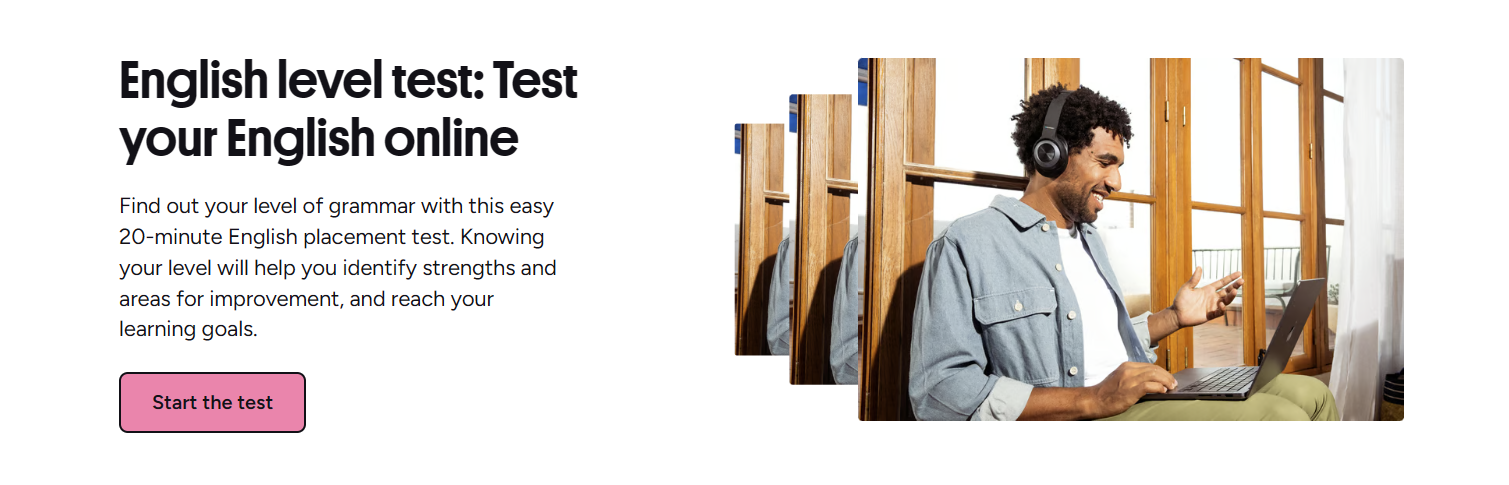
The Preply English level test serves as the starting point for most learners who join the platform. It's a free placement assessment designed to measure your current English proficiency and match you with tutors who teach at your level. Unlike standardized exams such as IELTS or TOEFL, this test focuses on practical placement rather than certification. The results help both you and potential tutors understand where you stand, what gaps exist, and how to structure lessons effectively from day one.
Contents
- 1. What Is the Preply English Level Test
- 2. How the Test Works: Format and Structure
- 3. What Skills Does the Test Assess
- 4. Understanding Your CEFR Level Results
- 5. Using Test Results to Find the Right Tutor
- 6. Preply English Vocabulary Test and Grammar Test
- 7. How Often Should You Retake the Test
- 8. Test Accuracy and Limitations
- 9. Comparing Preply's Test to Other Placement Tests
- 10. Getting Started: Taking the Test Step by Step
- 11. Preply Language Tests for Other Languages
- 12. Final Assessment of Preply English Level Test
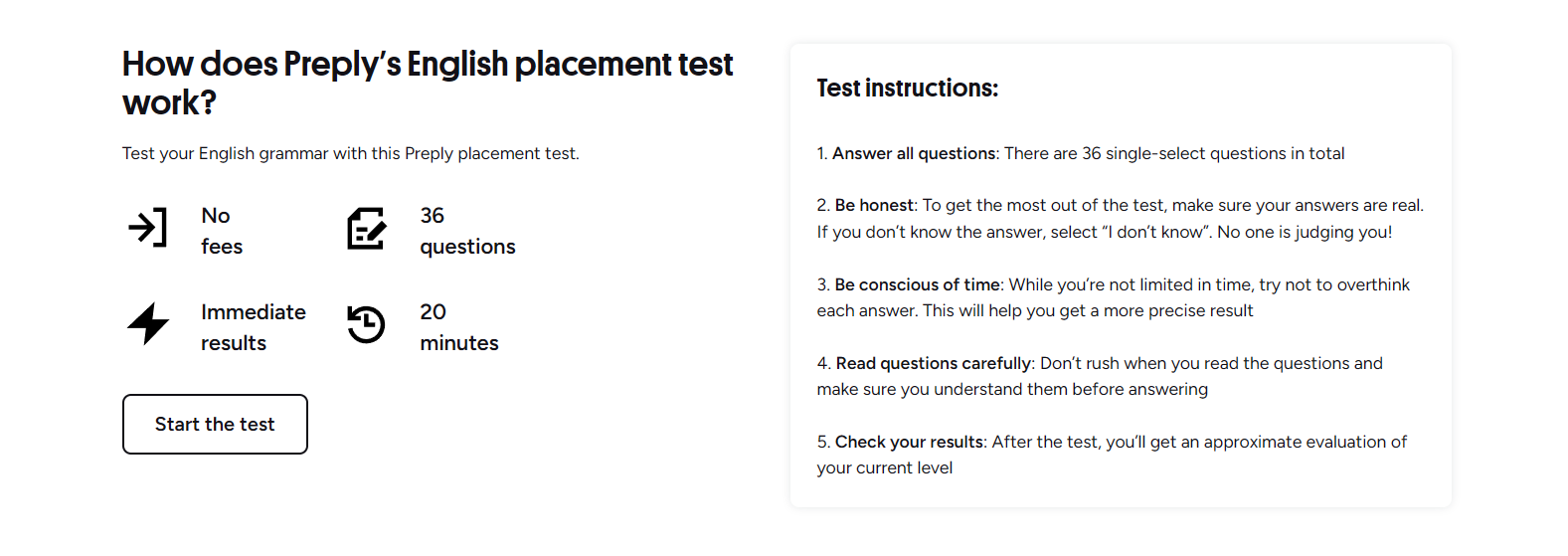
Many learners skip placement tests because they assume they know their level. That assumption often leads to mismatched lessons — either too easy and boring, or too difficult and frustrating. Preply's test removes that guesswork. It adapts to your responses, adjusting difficulty in real time, which means you spend less time on questions that are clearly above or below your ability. The whole process takes roughly 20 minutes, and you receive immediate results mapped to the Common European Framework of Reference for Languages (CEFR).
The test is not a one-time event. Preply encourages retesting every few months to track progress. Your level updates in your profile, and tutors can see your trajectory. This creates a feedback loop: test, learn, retest, adjust. For learners who want measurable progress without the pressure of formal exams, this approach works well. It also helps tutors prepare targeted materials before the first lesson, saving valuable session time.
What Is the Preply English Level Test
The Preply English level test is an adaptive online assessment that evaluates reading, listening, grammar, and vocabulary skills. It does not test speaking or writing directly — those require human evaluation. Instead, the test uses multiple-choice questions, fill-in-the-blank exercises, and short comprehension tasks to estimate your CEFR level from A1 (beginner) to C2 (proficient). The algorithm adjusts question difficulty based on your previous answers, which keeps the test efficient and reduces fatigue.
You can access the test directly from Preply's website without creating an account, though saving results requires registration. The test is free and available anytime. There's no proctoring, no time limit per question, and no penalty for wrong answers. This low-stakes design encourages honest responses rather than guessing strategies. The platform also offers separate vocabulary and grammar tests for learners who want deeper insight into specific areas.
Results appear immediately after completion. You see your overall CEFR level, a breakdown by skill area, and a list of recommended tutors who specialize in teaching at that level. The report also highlights strengths and weaknesses — for example, strong reading comprehension but weaker grammar accuracy. This granularity helps you choose a tutor whose teaching style matches your needs. A tutor who excels at conversation practice might not be the best fit if your grammar foundation needs work.
How the Test Works: Format and Structure
The test begins with a few demographic questions — your native language, learning goals, and self-assessed level. These don't affect scoring but help Preply refine tutor matches. Then the adaptive engine starts. Early questions cover basic grammar and high-frequency vocabulary. As you answer correctly, the system introduces more complex structures: conditionals, passive voice, nuanced vocabulary, and abstract reading passages. Incorrect answers pull the difficulty back down. This branching continues until the algorithm converges on a stable level estimate.
Question types include: selecting the correct word to complete a sentence, choosing the right verb form, identifying errors in short texts, matching words to definitions, and answering comprehension questions after reading a paragraph or listening to a short audio clip. Audio questions use clear, standard accents — mostly neutral American or British English. You can replay audio once. There are no long essays, no speaking prompts, and no timed sections. The total question count varies because the adaptive algorithm stops when confidence is high, usually around 30–40 questions.
- Grammar: verb tenses, conditionals, modals, passive voice, reported speech
- Vocabulary: collocations, idioms, phrasal verbs, academic and business terms
- Reading: short texts, emails, articles, instructions, opinion pieces
- Listening: dialogues, announcements, short lectures, phone messages
The test does not include pronunciation, speaking fluency, or writing production. Those skills require live interaction. Preply addresses this by letting tutors conduct their own diagnostic during the first lesson. Many tutors use the test result as a baseline and then run a quick speaking check to confirm or adjust. This two-step approach — automated placement followed by human verification — catches mismatches that pure algorithms miss.
Scroll horizontally to see all columns
| Skill Area | Question Types | Approx. Questions | Time Estimate |
|---|---|---|---|
| Grammar | Multiple choice, error detection | 10–15 | 5–7 minutes |
| Vocabulary | Fill-in-the-blank, matching | 8–12 | 4–6 minutes |
| Reading | Comprehension questions | 6–10 | 5–8 minutes |
| Listening | Audio + comprehension | 4–8 | 4–6 minutes |
What Skills Does the Test Assess
The test covers receptive skills — reading and listening — plus structural knowledge: grammar and vocabulary. Productive skills (speaking, writing) are not measured directly. This is a deliberate design choice. Automated scoring of speaking and writing remains unreliable at scale, especially across diverse accents and writing styles. By focusing on what machines can score consistently, Preply delivers fast, repeatable results. The trade-off is that you still need a tutor to evaluate your actual communication ability.
Grammar assessment targets the structures that most distinguish CEFR levels. At A1–A2, questions test present simple, past simple, basic prepositions, and common irregular verbs. B1–B2 introduces perfect tenses, conditionals, relative clauses, and modal nuances. C1–C2 covers advanced passive forms, inversion, subjunctive mood, and subtle register differences. Vocabulary follows a similar progression: high-frequency words at lower levels, then academic word list items, collocations, and low-frequency precision vocabulary at higher levels.
A placement test that skips speaking is incomplete, but a placement test that requires speaking cannot be instant and free. Preply chose speed and accessibility.
Reading passages range from simple signs and messages (A1) to opinion articles and technical summaries (C1). Listening follows the same arc: short daily-life dialogues at the start, then longer interviews, presentations, and abstract discussions. The audio quality is consistent, and speakers use standard pronunciation. This means the test measures comprehension of standard English, not your ability to understand heavy accents or noisy environments — which are real-world skills but harder to standardize.
Understanding Your CEFR Level Results
CEFR levels are the standard reference for language proficiency in Europe and increasingly worldwide. Preply maps your test score to one of six levels: A1 (Beginner), A2 (Elementary), B1 (Intermediate), B2 (Upper Intermediate), C1 (Advanced), C2 (Proficient). Each level describes what you can do in real-life situations. The test report shows your overall level plus a confidence range — for example, "B1 (high confidence)" or "B2/B1 borderline." This range matters. A borderline result means you're transitioning between levels, and your tutor should address both consolidation and extension.
The breakdown by skill often reveals asymmetry. Many learners score higher in reading than listening, or higher in grammar than vocabulary. This is normal. Language development is rarely even across all domains. A typical profile might show: Reading B2, Listening B1, Grammar B1, Vocabulary A2. This tells you and your tutor where to focus. If reading is strong but listening lags, lessons should include more audio input. If grammar is solid but vocabulary thin, the tutor can prioritize lexical expansion over structural drills.
Scroll horizontally to see all columns
| Level | Label | Typical Abilities |
|---|---|---|
| A1 | Beginner | Basic phrases, personal info, simple interactions |
| A2 | Elementary | Routine tasks, familiar topics, short exchanges |
| B1 | Intermediate | Main points of standard input, travel situations |
| B2 | Upper Intermediate | Complex texts, fluent interaction, detailed arguments |
| C1 | Advanced | Demanding texts, implicit meaning, flexible use |
| C2 | Proficient | Near-native comprehension, precise expression |
Your profile displays the level badge publicly unless you hide it. Tutors see it when you request a lesson or appear in their search results. This transparency helps tutors filter students they're equipped to teach. Some tutors specialize in beginners; others only take B2+. The level badge saves both parties time. You can also retake the test anytime. Preply stores your history, so you can see progress over months. The platform suggests retesting every 8–12 weeks if you're taking regular lessons.
One limitation: the test cannot distinguish between a learner who genuinely operates at B2 and one who guessed well on multiple-choice questions. The confidence indicator helps, but it's not foolproof. This is why the first lesson with a tutor matters. A good tutor will verify your level through conversation and adjust the learning plan accordingly. Treat the test result as a starting hypothesis, not a final verdict.
Using Test Results to Find the Right Tutor
After the test, Preply surfaces tutors who match your level and goals. The algorithm considers: tutor's stated teaching levels, specialization (business, exam prep, conversation, kids), availability in your time zone, price range, and student ratings. You can filter further by native/non-native speaker, additional languages spoken, and teaching certifications. The test result narrows the pool from thousands to dozens of relevant tutors, which makes the selection process manageable.
When reviewing tutor profiles, look for alignment between your weak areas and their strengths. If your test shows weak listening at B1, a tutor who emphasizes audio materials and dictation exercises will help more than one who focuses on grammar drills. Read tutor introductions and watch their video presentations. Many mention the levels they teach best. Some explicitly say "I love helping A2 students break through to B1" or "I specialize in C1+ academic writing." That specificity is more useful than a generic "all levels welcome."
- Filter by your exact CEFR level first
- Check tutor's specialization against your skill gaps
- Watch introduction videos for teaching style cues
- Read recent reviews from students at your level
- Book a 25-minute trial to verify fit before committing
The trial lesson is your real placement test. Use it to confirm the automated result. Ask the tutor to assess your speaking and writing briefly. Share your test report and discuss whether they agree. A tutor who dismisses the test entirely may not use data-driven planning. One who treats it as a useful baseline but verifies independently is ideal. Also note how the tutor structures the trial: do they diagnose first, then teach? Or do they jump into a generic lesson? The former signals professionalism.
Preply English Vocabulary Test and Grammar Test
Beyond the main level test, Preply offers two focused assessments: the English Vocabulary Test and the English Grammar Test. These are shorter, domain-specific tools for learners who want granular insight. The vocabulary test draws from frequency lists and academic word lists, testing recognition of words at each CEFR band. The grammar test isolates structural knowledge without reading or listening distractions. Both use the same adaptive engine and CEFR mapping.
These focused tests are useful when your main level test shows a significant split — for example, overall B2 but vocabulary at B1. Retaking the full test won't give you more vocabulary detail. The vocabulary test will. It breaks results down by frequency bands: top 1,000 words, 1,000–3,000, 3,000–5,000, academic vocabulary, and specialized domains. You see exactly which bands you've mastered and where gaps remain. This lets you and your tutor build a targeted word-learning plan instead of generic vocabulary lists.
The grammar test works similarly. It categorizes structures by CEFR level and shows mastery per category: verb forms, clause types, modality, determiners, prepositions, and so on. A learner might ace conditionals but struggle with article usage. That precision matters because article errors persist even at high levels and affect perceived fluency. Tutors can assign specific grammar modules from Preply's library based on these results, creating a more efficient study path than working through a textbook sequentially.
Scroll horizontally to see all columns
| Test | Duration | Focus | Best For |
|---|---|---|---|
| Main Level Test | 20 min | Overall proficiency + skills | Initial placement, tutor matching |
| Vocabulary Test | 10 min | Word knowledge by frequency band | Targeted lexical gaps |
| Grammar Test | 10 min | Structural knowledge by category | Pinpointing persistent errors |
Knowing you're 'B2 vocabulary' is vague. Knowing you've mastered the top 3,000 words but miss 40% of the academic word list is actionable.
How Often Should You Retake the Test
Preply recommends retesting every 8–12 weeks for active learners. This interval balances measurable progress with test fatigue. Language acquisition isn't linear — you might plateau for weeks then jump a sub-level after a breakthrough. Testing too often (weekly) captures noise, not signal. Testing too rarely (yearly) misses the chance to adjust your learning plan. The 8–12 week window aligns with typical course cycles and gives tutors enough sessions to impact measurable skills.
Your retest schedule should also reflect intensity. If you take three lessons per week plus self-study, 8 weeks is reasonable. If you manage one lesson every two weeks, extend to 12–16 weeks. The platform sends optional reminders based on your lesson frequency, but you control the timing. Retesting before a major goal — job interview, exam, relocation — is smart even if it's early. The updated level helps you and your tutor prioritize the right prep in remaining sessions.
- Active learners (3+ lessons/week): retest every 8 weeks
- Moderate learners (1–2 lessons/week): retest every 10–12 weeks
- Casual learners (<1 lesson/week): retest every 12–16 weeks
- Before major milestones: retest regardless of schedule
- After completing a course module: retest to validate progress
Progress isn't always a level jump. Moving from low B1 to high B1 is real progress even if the label doesn't change. The skill breakdown often shows movement before the overall level shifts. Track the sub-scores. A 15-point gain in listening while grammar stays flat tells you your input practice is working but output needs attention. Share these trends with your tutor. They can adjust the lesson balance — more listening tasks, more speaking drills — based on data, not guesswork.
Test Accuracy and Limitations
No automated placement test is perfect. Preply's test correlates well with CEFR for receptive skills and structural knowledge, but it has blind spots. The biggest is speaking. A learner with strong passive knowledge but frozen speaking ability will test higher than their functional level. Conversely, a fluent speaker with fossilized grammar errors might test lower than their communication effectiveness warrants. The test also favors test-taking skills: pattern recognition, multiple-choice strategy, and comfort with standard accents.
Cultural bias exists in any standardized test. Reading passages reflect Western contexts — emails about meetings, articles about technology, dialogues about travel. Learners from different cultural backgrounds may find some scenarios unfamiliar, not because of language gaps but because of content gaps. Preply mitigates this by using universal topics where possible, but complete neutrality is impossible. The vocabulary test draws from corpus data that overrepresents academic and business English, underrepresenting daily-life slang, regional varieties, and digital communication norms.
Technical factors matter too. Taking the test on a phone with a small screen, in a noisy room, or with a slow connection can depress scores. The listening section especially needs decent audio and focus. Preply doesn't enforce environment controls — that's on you. For the most accurate result, use a desktop or tablet, headphones, and a quiet 25-minute block. Treat it like a mini-exam. The result follows you in tutor matching, so a rushed attempt can lead to mismatched lessons for weeks.
Scroll horizontally to see all columns
| Limitation | Impact | Mitigation |
|---|---|---|
| No speaking assessment | Overestimates passive learners | Tutor verifies in trial lesson |
| No writing assessment | Misses production gaps | Tutor assigns writing task early |
| Standard accents only | Underprepares for real variety | Supplement with diverse media |
| Multiple-choice format | Allows guessing, test-taking skills | Confidence indicator flags uncertainty |
| Cultural context bias | Unfamiliar scenarios lower scores | Focus on language, not content knowledge |
Comparing Preply's Test to Other Placement Tests
Several platforms offer free English placement tests: British Council, Cambridge, EF SET, Oxford Online, and various language school sites. Preply's test differs in purpose. Most others aim to give you a standalone level certificate or course recommendation. Preply's test aims to match you with a human tutor on its platform. The questions are similar — all draw from CEFR-aligned item banks — but the output differs. Preply outputs tutor matches; others output course levels or PDF certificates.
EF SET (EF Standard English Test) is the closest competitor in scope. It's longer (50 minutes for the full version), tests reading and listening more deeply, and provides a detailed certificate aligned to CEFR and IELTS/TOEFL equivalents. It's more rigorous but less convenient. Preply's test is faster, integrated into a tutoring marketplace, and actionable immediately — you see tutors, not just a score. If you need a certificate for an employer, EF SET or a paid exam is better. If you need a tutor tomorrow, Preply's test gets you there faster.
Cambridge's free test is shorter and less adaptive. It gives a rough band (A2, B1, etc.) but no skill breakdown. British Council's test is similar. Oxford's test is adaptive but requires account creation and feels more academic. Preply's advantage is the ecosystem: test → tutor → lessons → progress tracking → retest. The loop closes. Other tests end at the score. For a self-directed learner who wants structure without a fixed curriculum, Preply's integration matters more than marginal accuracy differences.
A test that leads to a tutor beats a test that leads to a PDF. The conversation starts where the score ends.
Getting Started: Taking the Test Step by Step
Taking the test is straightforward. Go to Preply's website and navigate to the English level test page — it's accessible from the main menu under "Language Tests" or via direct link. No login required to start. Click "Start Test." The first screen asks for your native language and learning goal (work, travel, exam, general). Select the closest match. This doesn't affect scoring but influences tutor recommendations later.
The test begins immediately. Read each question carefully. There's no timer, but don't overthink — your first instinct is usually your true level. If you're unsure, guess. The adaptive algorithm accounts for lucky guesses through confidence tracking. Answer all questions. The test ends automatically when the system has enough data. You'll see a loading screen for a few seconds, then your results page with overall level, skill breakdown, and tutor recommendations.
- Visit Preply's English level test page
- Select native language and learning goal
- Complete adaptive questions (20–25 minutes)
- Review CEFR level and skill breakdown
- Browse recommended tutors or save results
- Create account to save history and retest later
If you create an account after the test, your results attach to your profile. If you already have an account, log in first — the test will update your existing level badge. You can retake anytime from your dashboard. The history shows previous scores with dates, so you can track trajectory. Tutors see your current level only, not the full history, unless you share it. This keeps the profile clean while giving you the data.
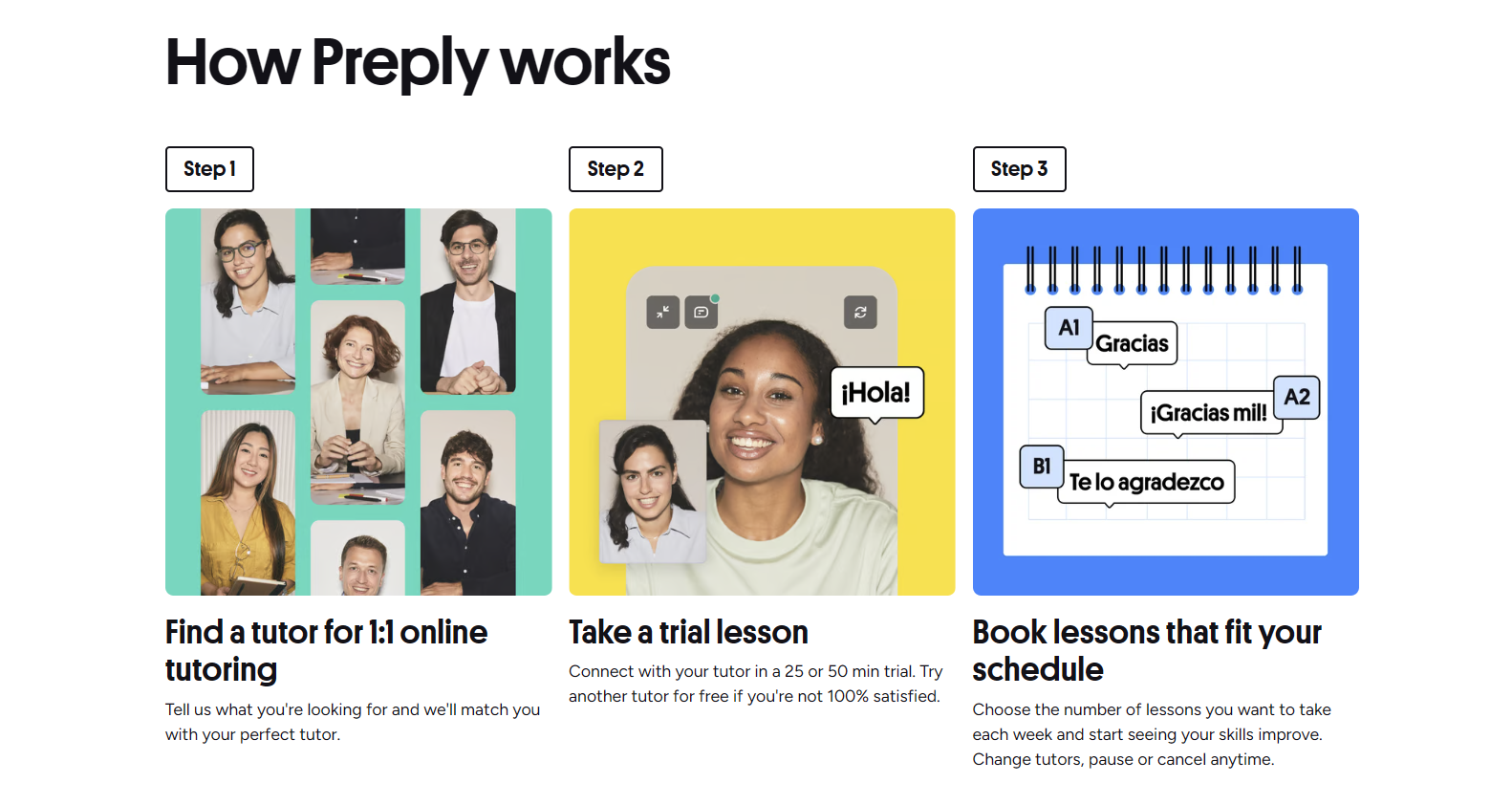
After seeing results, browse the recommended tutors. Filter by availability, price, and specialization. Book a 25-minute trial lesson with 1–3 tutors. Use the trial to verify the test level and assess teaching chemistry. Share your test report in the chat before the lesson so the tutor can prepare. Most tutors appreciate the head start. After trials, choose your tutor and schedule regular lessons. Set a calendar reminder to retest in 8–12 weeks.
Preply Language Tests for Other Languages
Preply offers similar placement tests for Spanish, German, French, Italian, Portuguese, Chinese, Japanese, Korean, Arabic, Russian, and Greek. Each follows the same adaptive design and CEFR mapping. The question banks are language-specific, developed with native-speaking linguists. If you're learning multiple languages on Preply, you can take each test and maintain separate level badges. This is useful for polyglots or learners studying a second language alongside English.
The non-English tests are newer and have smaller item banks, so they may be slightly less precise at the extremes (A1 and C2). For the middle bands (A2–B2), they're reliable. Preply updates them regularly based on learner data. If you're a beginner in a new language, the test helps you avoid the common mistake of starting with materials that are too advanced. Many learners overestimate their level in a new language because they transfer expectations from their stronger languages.
Final Assessment of Preply English Level Test
The Preply English level test does what it promises: a fast, free, adaptive placement that connects you with suitable tutors. It's not a proficiency certificate, and it doesn't measure speaking or writing. But for its intended purpose — getting the right tutor from day one — it works well. The CEFR mapping is standard, the skill breakdown is actionable, and the integration with tutor search saves hours of browsing. The focused vocabulary and grammar tests add depth for learners who want to target specific gaps.
The main limitation is the speaking blind spot. Any placement test without speaking is incomplete for communication-focused learners. The workaround is simple: treat the test as a starting point, then use the trial lesson for real verification. Tutors who take the test seriously and verify independently deliver better outcomes. Tutors who ignore it or treat it as gospel both miss the point. The test is a tool, not a verdict.
For learners already on Preply, the retest cycle creates accountability. Seeing sub-scores move — even without a level jump — provides motivation that vague "I'm improving" feelings don't. The history view turns language learning into a measurable project. That's valuable for self-directed adults who need structure without a classroom. If you're considering Preply, take the test. It costs nothing, takes 20 minutes, and either confirms your self-assessment or reveals a gap worth addressing. Either way, you start lessons with better information.
Frequently Asked Questions
Is the Preply English level test free?
Yes, the test is completely free. You can take it without creating an account, though saving results requires free registration.
How long does the Preply English level test take?
The adaptive test typically takes 20–25 minutes. The focused vocabulary and grammar tests take about 10 minutes each.
Does the Preply test give a certificate?
No. It provides a CEFR level estimate for tutor matching only. It is not a recognized certificate for visas, universities, or employers.
Can I retake the Preply English level test?
Yes, you can retake it anytime. Preply recommends every 8–12 weeks for active learners. Your history is saved in your profile.
Does the test assess speaking and writing?
No. The test covers reading, listening, grammar, and vocabulary only. Speaking and writing require human evaluation during lessons.
How accurate is the Preply English level test?
It correlates well with CEFR for receptive skills and structural knowledge. Speaking ability may differ from the test result, so verify with a tutor.
What if I disagree with my test result?
Discuss it with your tutor during the trial lesson. They can run a quick speaking diagnostic and adjust your learning plan accordingly.
Are there Preply level tests for other languages?
Yes, Preply offers placement tests for Spanish, German, French, Italian, Portuguese, Chinese, Japanese, Korean, Arabic, Russian, and Greek.