
Language Learning
Preply English Exam Preparation Courses: What You Need to Know
Compare tutors, pricing, and features for IELTS, TOEFL, and more.
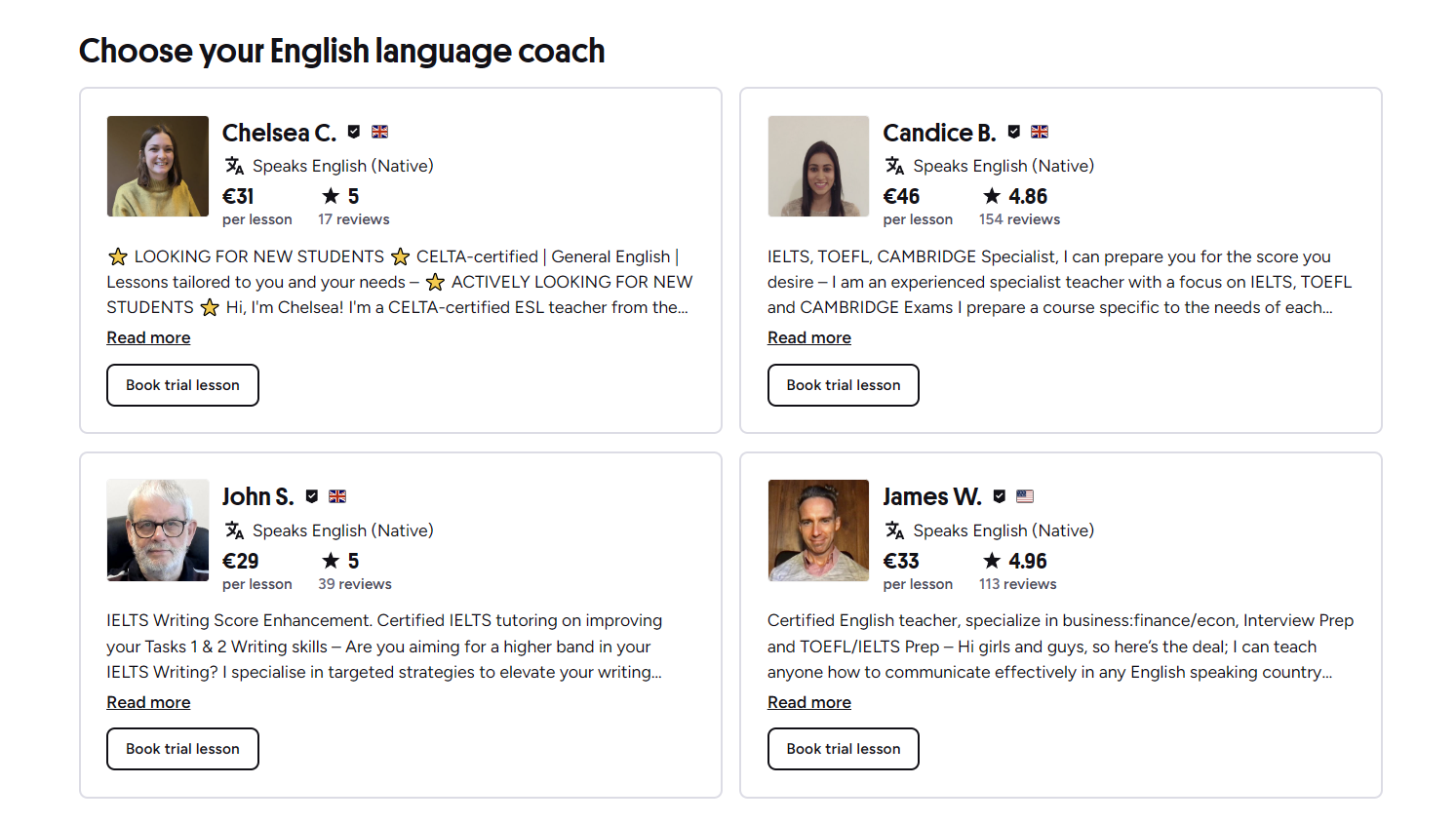
Preply has become a go-to platform for learners who need targeted help with English proficiency exams. The marketplace connects students with tutors who specialize in IELTS, TOEFL, Cambridge exams, PTE, and a handful of other standardized tests. What makes it different from a traditional prep course is the one-on-one format: you choose a tutor, set a schedule, and work on the specific sections where you struggle most. That flexibility is the main draw, but it also means quality varies depending on who you pick.
Contents
- 1. How Preply Exam Preparation Works
- 2. Finding the Right Tutor for Your Exam
- 3. IELTS Preparation on Preply
- 4. TOEFL Preparation on Preply
- 5. Other English Exams: Cambridge, PTE, OET, and More
- 6. Preply English Level Test and Placement
- 7. Lesson Structure and Materials
- 8. Pricing and Subscription Options
- 9. Progress Tracking and Feedback
- 10. Mobile App for Exam Prep
- 11. Pros and Cons of Preply for Exam Prep
- 12. Comparing Preply to Alternatives
- 13. Getting Started: A Practical Checklist
- 14. Final Assessment of Preply English Exam Preparation Courses
Most people arrive at Preply with a deadline — a university admission requirement, a visa application, or a job offer that hinges on a minimum score. The platform doesn't administer exams itself. It provides the human element: a tutor who knows the test format, can simulate speaking interviews, grades writing tasks, and explains why you keep missing certain reading questions. If you're self-disciplined and know exactly what you need, this model works well. If you want a structured curriculum with progress benchmarks built in, you'll have to build that structure yourself or find a tutor who provides it.
The tutor pool is large. At any given time there are hundreds of profiles tagged for IELTS or TOEFL preparation. Many tutors hold teaching certifications like CELTA or DELTA, and some are former examiners. That said, the platform doesn't verify exam-specific expertise beyond what tutors claim in their profiles. Reviews help, but they're often written after a few lessons, not after the student receives their official score. So the onus is on you to vet the tutor's actual experience with the test you're taking.
How Preply Exam Preparation Works
You start by filtering tutors for your target exam. The search lets you sort by price, rating, availability, and whether the tutor is a native speaker. Each profile shows a video introduction, hourly rate, number of lessons taught, and student reviews. Once you pick someone, you book a trial lesson — usually 30 or 60 minutes at a discounted rate — to see if the teaching style fits. After that, you buy a package of hours (5, 10, 15, or 20) and schedule recurring sessions. Lessons happen over Preply's built-in video classroom, which includes a whiteboard, file sharing, and chat. The platform handles reminders, time-zone conversion, and payment.
- Filter tutors by exam specialization (IELTS, TOEFL, Cambridge, PTE, others).
- Watch video intros and read reviews focused on exam prep.
- Book a trial lesson to assess tutor familiarity with test format.
- Purchase hour packages; unused hours roll over month to month.
- Use the Preply classroom for screen sharing, annotations, and homework uploads.
There's no fixed curriculum. Some tutors follow published prep books (Cambridge IELTS series, Official TOEFL iBT guides) and assign homework from them. Others create custom materials based on your diagnostic results. The platform itself doesn't provide a syllabus, practice tests, or score predictors. If you want full-length mock exams, you'll need to source them separately or ask your tutor to supply them.
Finding the Right Tutor for Your Exam
The search filters are your first line of defense. Type "IELTS" or "TOEFL" in the specialty field and you'll see tutors who tagged those exams. But tags don't guarantee depth. A tutor might have helped one student with IELTS speaking three years ago and still keep the tag. Look for profiles that mention specific scores their students achieved, years of exam-focused teaching, or examiner experience. The video intro often reveals more than the text: does the tutor discuss band descriptors, timing strategies, or common traps? That's a better signal than a generic "I help students pass."
Reviews are useful but read them critically. A five-star review that says "Great teacher, very friendly" tells you nothing about exam prep. Look for reviews that mention score improvements, specific sections (writing task 2, speaking part 3), or the tutor's ability to simulate real test conditions. If a tutor has dozens of reviews but none reference exam results, they may be a great general English teacher but not an exam specialist.
IELTS Preparation on Preply
IELTS is the most requested exam on the platform. Tutors typically split preparation by module: Listening, Reading, Writing Task 1 and 2, Speaking Parts 1-3. Many tutors are former IELTS examiners or have completed the IELTS Teacher Training program. That background matters because they understand the band descriptors — the exact criteria examiners use to assign scores. A tutor who can explain why your writing sits at Band 6.5 instead of 7.0 saves you weeks of guesswork.
Speaking practice is where Preply shines. The video classroom approximates the face-to-face interview format. Tutors can run timed mock speaking tests, record them (with permission), and give feedback on fluency, lexical resource, grammatical range, and pronunciation — the four marking criteria. For writing, tutors usually ask you to submit essays before the lesson so they can annotate them live. Some provide corrected versions with band estimates. Reading and listening are harder to teach one-on-one; most tutors assign practice tests as homework and review wrong answers during the session.
Scroll horizontally to see all columns
| Module | Common Tutor Activities | Self-Study Gap |
|---|---|---|
| Speaking | Mock interviews, pronunciation drills, part 2 cue card practice | No real-time examiner feedback |
| Writing | Essay correction, task response analysis, grammar/vocab upgrades | No objective band score |
| Reading | Strategy walkthroughs, time management, question-type patterns | Limited explanation of wrong answers |
| Listening | Note-taking techniques, accent exposure, section 4 strategies | Hard to simulate test conditions alone |
TOEFL Preparation on Preply
TOEFL iBT prep follows a similar pattern but with different pain points. The speaking section is recorded, not live, so tutors focus on structuring responses within the strict 45-60 second limits, using templates for independent and integrated tasks. Writing involves integrated tasks (reading + listening → essay) and independent essays. Tutors who know the e-rater scoring engine can warn you about length, transition phrases, and grammar patterns that the automated system rewards or penalizes. Reading and listening are multiple-choice; tutors teach elimination strategies and note-taking for the longer academic passages.
One advantage of Preply for TOEFL is accent exposure. The test includes North American, British, Australian, and New Zealand accents. You can deliberately choose tutors from different regions to train your ear. The platform's global tutor base makes this easy — just filter by country. For speaking, some tutors use the official TOEFL practice software or ETS's free practice sets during lessons to simulate the interface.
The platform's strength is tutor variety, not a standardized curriculum.
Other English Exams: Cambridge, PTE, OET, and More
Beyond IELTS and TOEFL, you'll find tutors for Cambridge B2 First, C1 Advanced, C2 Proficiency, PTE Academic, OET (for healthcare professionals), and Duolingo English Test. The tutor pool thins out for less common exams. Cambridge prep is well represented because many tutors are based in Europe and teach those exams regularly. PTE has grown in popularity for Australian and New Zealand visas; tutors often emphasize the automated scoring quirks — like the need for clear enunciation and avoiding long pauses. OET is niche; look for tutors with medical English backgrounds. Duolingo English Test prep is newer on the platform; tutors focus on the adaptive format and the video interview portion.
- Cambridge B2/C1/C2: Strong tutor availability in Europe.
- PTE Academic: Focus on automated scoring criteria.
- OET: Requires medical English specialization.
- Duolingo English Test: Adaptive format and video interview practice.
- TOEIC: Less common on Preply; more tutors on specialized platforms.
Preply English Level Test and Placement
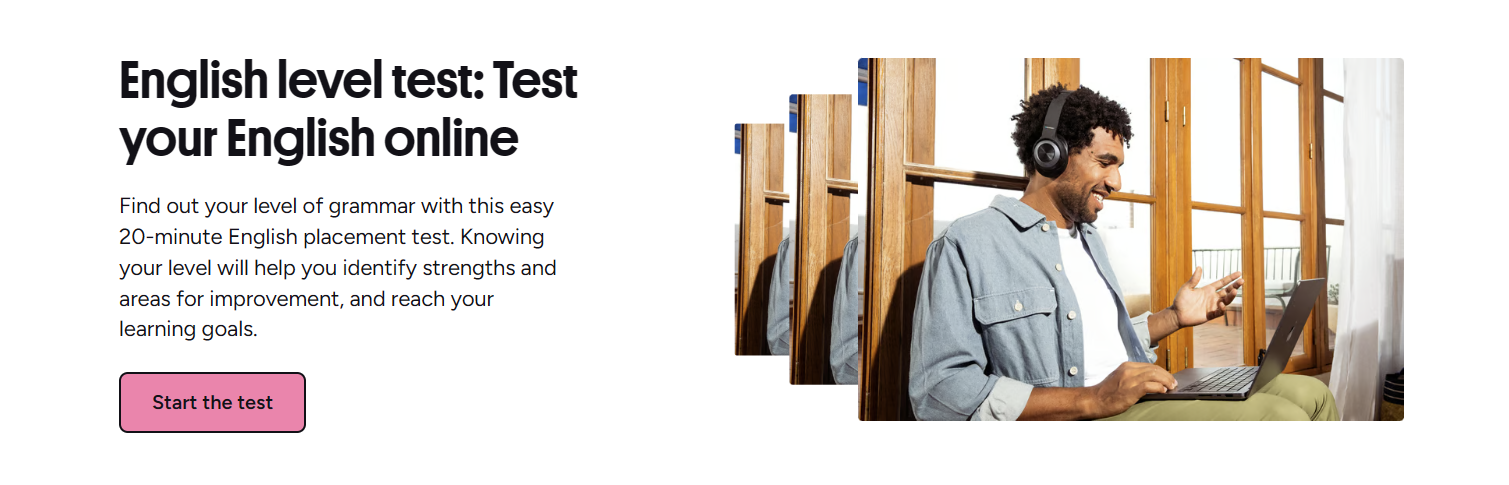
Preply offers a free English level test that takes about 20 minutes. It covers grammar, vocabulary, and reading comprehension. The result maps to CEFR levels (A1-C2). It's a decent starting point for you and your tutor to gauge where you stand, but it's not a mock exam. The questions don't mirror IELTS or TOEFL formats, and there's no speaking or writing component. Treat it as a rough baseline, not a predictor. Some tutors ignore it entirely and run their own diagnostic in the first lesson.
If you're serious about an exam, take an official practice test first. Cambridge, British Council, and ETS all publish free or low-cost sample tests. Bring those results to your trial lesson. A tutor who can interpret an official practice test score is far more valuable than one who relies on Preply's internal test.
Lesson Structure and Materials
A typical 60-minute exam prep lesson might spend 10 minutes reviewing homework, 30 minutes on a new skill or strategy, and 20 minutes on guided practice with immediate feedback. Tutors often share their screen to walk through a reading passage, annotate a writing sample, or demonstrate note-taking for listening. The Preply classroom supports PDF uploads, so tutors can load practice tests, vocabulary lists, or grammar exercises. Many tutors also use external resources: Google Docs for collaborative writing, Quizlet for vocabulary, YouTube for listening clips. The platform doesn't restrict external tools.
Homework is where progress happens. Good tutors assign specific tasks: write one Task 2 essay, complete a full reading passage under timed conditions, record a speaking response. They review it before the next lesson so session time isn't spent reading silently. If your tutor doesn't assign homework or doesn't review it, that's a red flag for exam prep.
For exam prep, the tutor's familiarity with the test format is everything.
Pricing and Subscription Options
Preply tutors set their own hourly rates. For exam specialists, expect $15-$40 per hour for tutors from countries with lower costs of living, and $40-$80+ for tutors based in the US, UK, Canada, or Australia. Former examiners and highly rated specialists often charge $60-$100. You buy hour packages: 5, 10, 15, or 20 hours. The per-hour price drops slightly with larger packages. Unused hours roll over as long as your subscription is active. If you cancel, unused hours expire after a period (check current terms). There's no monthly subscription fee — you pay for the package upfront.
Scroll horizontally to see all columns
| Tutor Profile | Rate Range (USD/hr) | Notes |
|---|---|---|
| Non-native, certified, 3+ years exam experience | $15-$30 | Often excellent value |
| Native speaker, general ESL background | $25-$45 | May lack exam-specific training |
| Former examiner / exam specialist | $50-$100 | Highest insight into scoring |
| Top-rated with proven score improvements | $40-$80 | Demand drives price |
Progress Tracking and Feedback
Preply's dashboard shows lesson count, hours used, and a progress graph based on tutor assessments. Tutors can rate your level after each lesson (speaking, listening, reading, writing) on a 1-5 scale. Over time this builds a trend line. It's a rough proxy — not tied to any official scale — but it helps you see if you're moving in the right direction. Some tutors provide detailed lesson notes: vocabulary covered, errors corrected, homework assigned. You can export these notes. The platform doesn't generate automated reports or predicted scores.
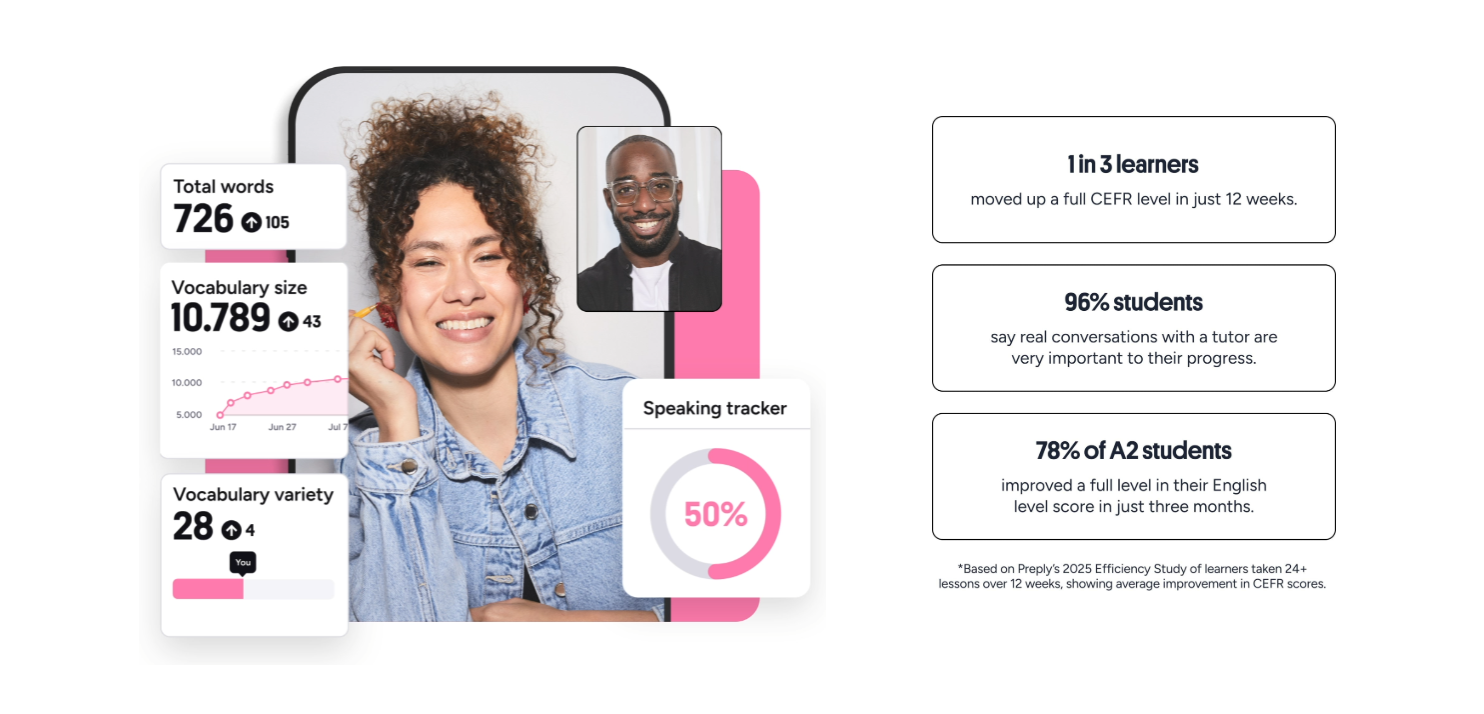
For exam prep, the most meaningful tracking is mock test scores. Ask your tutor to administer a full practice test every 3-4 weeks under timed conditions. Record the scores in a spreadsheet. That's the only metric that correlates with your actual exam result. Preply's internal progress graph is a nice visual but doesn't replace real practice test data.
Mobile App for Exam Prep
Preply's mobile app (iOS and Android) mirrors the desktop experience. You can take lessons on your phone, review tutor notes, chat with tutors, and manage your schedule. The video classroom works over mobile data, though a stable Wi-Fi connection is better for screen sharing. For exam prep, the app is handy for fitting in speaking practice during a commute or reviewing vocabulary flashcards between lessons. Some tutors send homework files through the app chat. The app also sends push notifications for upcoming lessons and tutor messages.
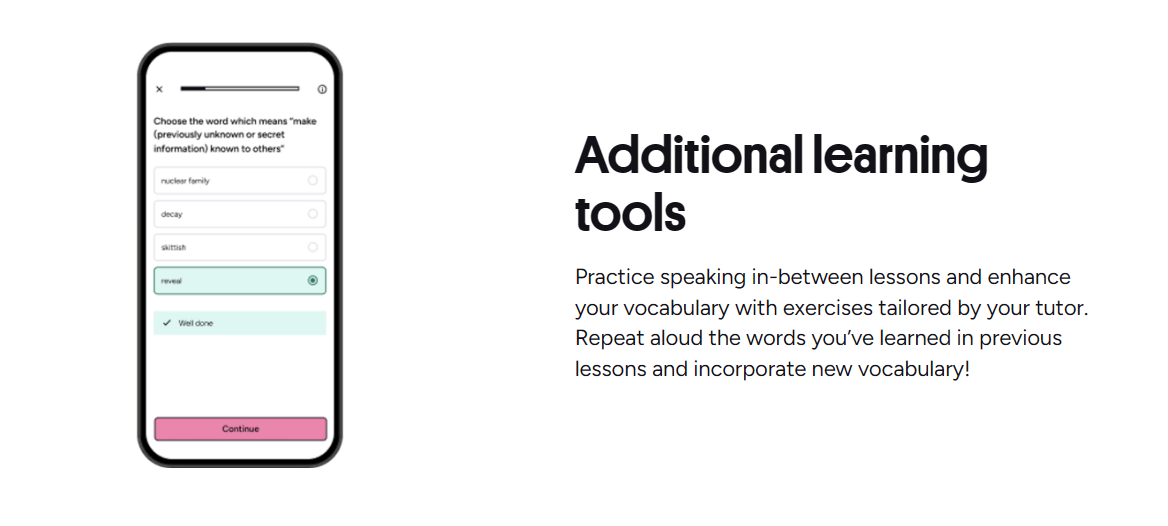
One limitation: writing essays on a phone screen is painful. If your lesson involves live writing correction, use a laptop or tablet. The app is best for speaking, listening, and review.
Pros and Cons of Preply for Exam Prep
The platform's main strength is access to specialized tutors worldwide at various price points. You can find a former IELTS examiner in Manchester, a TOEFL specialist in Toronto, or a PTE coach in Sydney — all without leaving home. The one-on-one format means every minute addresses your weaknesses. The main weakness is the lack of built-in structure. There's no curriculum, no official practice tests, no score guarantee. You're hiring a guide, not enrolling in a course. Quality control is decentralized: Preply verifies identity and teaching credentials but doesn't audit exam-specific competence. Refunds for unused hours are possible but subject to conditions. The platform takes a commission (18-33% depending on tutor tenure), which is baked into the hourly rate.
- Pro: Targeted one-on-one focus on your weak sections.
- Pro: Global tutor pool — find specialists for any major exam.
- Pro: Flexible scheduling across time zones.
- Pro: Pay-as-you-go packages; no long-term contract.
- Con: No standardized curriculum or materials provided.
- Con: Tutor quality varies; vetting is your responsibility.
- Con: No official practice tests or score predictors included.
- Con: Platform commission inflates tutor rates slightly.
Preply's level test gives a rough starting point, but it's not a mock exam.
Comparing Preply to Alternatives
If you want a self-paced course with video lessons, practice questions, and score predictors, look at Magoosh, Kaplan, or the official British Council/ETS prep products. They're cheaper per hour but lack live feedback. If you want a structured group class with a fixed syllabus, local language schools or online academies (like IELTS Advantage, E2Language) offer that. Preply sits in the middle: more personalized than a course, less structured than a class. Some students combine approaches — use a self-study course for content review and a Preply tutor for speaking/writing feedback. That's often the most cost-effective route.
Scroll horizontally to see all columns
| Feature | Preply (1-on-1) | Self-Study Course | Group Class |
|---|---|---|---|
| Personalization | High | Low | Medium |
| Speaking feedback | Live, immediate | Automated or none | Limited per student |
| Writing correction | Detailed, human | Automated or peer | Instructor, but less time |
| Cost per hour | $15-$100 | $5-$20 (amortized) | $10-$30 |
| Schedule flexibility | Full | Full | Fixed |
| Materials included | Tutor-dependent | Yes | Yes |
Getting Started: A Practical Checklist
Before you book your first trial, do these three things. First, take an official practice test for your target exam. Note your overall score and section breakdown. Second, define your timeline and target score. Are you three months out needing a 7.0 overall with 7.5 in writing? Or six weeks out needing a 100 on TOEFL? Third, shortlist 4-5 tutors who explicitly mention your exam, have relevant reviews, and fit your budget. Book trials with all of them in the same week. Compare their diagnostic approach, materials, and communication style. Pick the one who gives you a concrete plan and makes you feel confident.
- Take an official practice test (not Preply's level test).
- Set a realistic target score and deadline.
- Shortlist 4-5 exam-specialist tutors.
- Book trial lessons within the same week.
- Ask each tutor for a 4-8 week prep plan.
- Choose based on plan clarity, not just personality.
Frequently Asked Questions
Does Preply provide official IELTS or TOEFL practice tests?
No. Preply connects you with tutors. Some tutors share official practice materials, but the platform itself doesn't include them.
Can I get a refund if I don't achieve my target score?
Preply's refund policy covers unused lesson hours, not exam outcomes. Score guarantees are between you and your tutor.
How many lessons do I need for IELTS preparation?
It depends on your current level and target. Most students take 10-20 hours over 1-3 months. A diagnostic lesson helps estimate.
Are native speakers better for exam prep?
Not necessarily. Non-native tutors with examiner experience often know the test criteria better than native speakers without that background.
Can I switch tutors if the first one isn't a good fit?
Yes. Unused hours stay in your account. You can book with a different tutor anytime.
Does Preply work for PTE Academic preparation?
Yes, there are PTE specialists on the platform. Filter for PTE in the specialty search and verify their students' score reports.
Is the Preply classroom good enough for speaking mock tests?
The video and audio quality are solid. For speaking practice, it closely simulates the face-to-face or recorded interview environment.
Final Assessment of Preply English Exam Preparation Courses
Preply is a solid choice if you know what you need and can vet tutors effectively. It excels at speaking and writing feedback — the two sections hardest to improve alone. The tutor variety means you can find someone who matches your budget, timezone, and exam focus. But it's not a turnkey solution. You'll supply the discipline, the practice tests, and the structure. If you treat it as a supplement to self-study or a targeted fix for weak sections, it delivers. If you expect a guided course with guaranteed results, you'll be disappointed. The platform gives you access; the outcome depends on the tutor you choose and the work you put in between lessons.