
Language Learning
Preply Greek Tutors: Finding the Right Teacher for You
A practical guide to choosing Greek language tutors on Preply based on goals, budget, and learning style.
Preply has become one of the larger marketplaces for online language tutoring, and Greek is one of the many languages you can study there. The platform connects students with tutors who set their own rates, schedules, and teaching approaches. For someone wanting to learn Greek — whether modern conversational Greek, ancient Greek for academic work, or specialized vocabulary for business or travel — the sheer number of options can feel overwhelming at first. This guide walks through how the platform works specifically for Greek learners, what to look for in a tutor, and how to make the most of the tools Preply provides.
Contents
- 1. How Preply Works for Greek Learners
- 2. Types of Greek Tutors Available
- 3. Filtering and Search Tools
- 4. Trial Lessons and What to Expect
- 5. Pricing Structure and Payment Options
- 6. Scheduling Flexibility and Time Zones
- 7. Learning Modern vs Ancient Greek
- 8. Specialized Greek: Business, Travel, Exam Prep
- 9. Tutor Qualifications and Reviews
- 10. Mobile App and Platform Features
- 11. Progress Tracking and Lesson Materials
- 12. Common Pitfalls and How to Avoid Them
- 13. Comparing Preply to Alternatives for Greek
- 14. Final Assessment of Preply Greek Tutors
The core idea is straightforward: you create an account, answer a few questions about your goals and current level, and the system suggests tutors who match your criteria. You can then filter those results by price range, availability, tutor nationality, specialties, and student ratings. Most tutors offer a trial lesson at a reduced rate, usually 30 or 50 minutes, so you can test the fit before committing to a package. Preply takes a commission on each lesson, and tutors receive payment after the session completes. The platform handles scheduling, video calls, payments, and basic progress tracking.
Greek presents some unique challenges compared to more widely taught languages like Spanish or French. The alphabet is different, the grammar includes cases and verb aspects that don't exist in English, and pronunciation rules take practice. A good tutor will structure lessons around these hurdles rather than treating Greek like any other language. On Preply, you'll find native speakers from Greece and Cyprus, as well as non-native tutors who have achieved high proficiency and teach professionally. Both categories can be effective, but they often bring different strengths — natives for intuition and cultural context, non-natives for explicit grammar explanations and learning strategies.
How Preply Works for Greek Learners
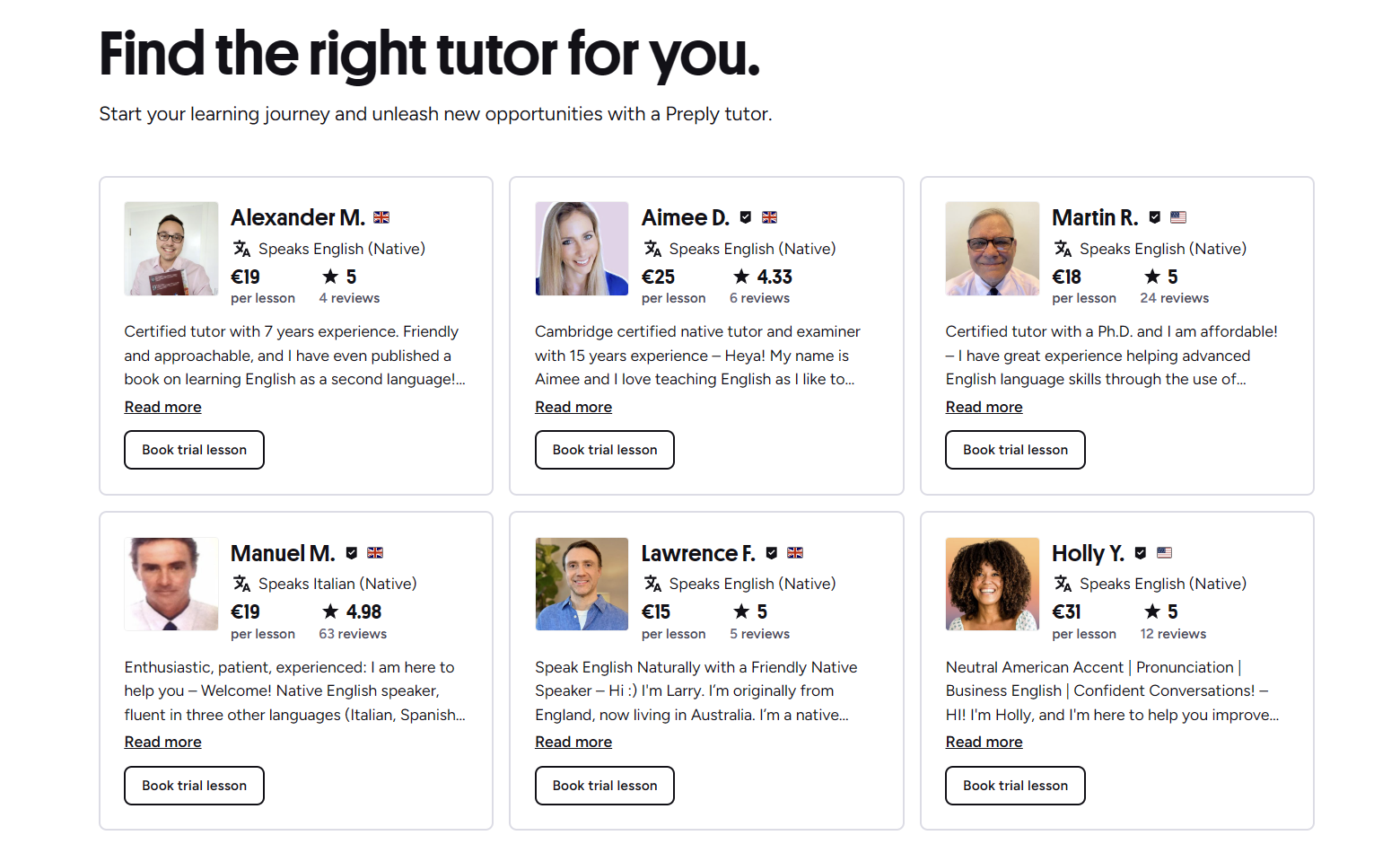
When you first search for Greek tutors, the platform asks about your learning goal: general conversation, grammar, business, travel, exam preparation, or something else. It also asks for your current level — beginner, intermediate, or advanced — and your preferred lesson frequency. These answers feed the recommendation algorithm, but you can ignore them and browse the full tutor list manually. The search results show each tutor's photo, name, country, hourly rate, rating, number of reviews, and a short tagline. Clicking a profile reveals a video introduction, detailed bio, teaching specialties, availability calendar, and student reviews.
The booking flow is simple. Pick a time slot from the tutor's calendar, confirm the time zone (Preply detects yours automatically), and pay for the trial or a package of hours. Packages come in blocks of 5, 10, 15, or 20 hours, with a small per-hour discount for larger bundles. You can also pay per lesson without a package, though the hourly rate is slightly higher. After booking, the lesson appears in your dashboard with a join button that activates at the scheduled time. The video classroom runs in the browser — no separate download required — and includes a shared whiteboard, chat, file sharing, and screen sharing.
One practical detail: Preply's cancellation policy requires at least 4 hours' notice to reschedule or cancel without charge. Lessons cancelled later are charged in full. Tutors can also cancel, in which case you receive a full credit refund automatically. The platform sends email and push notifications for upcoming lessons, schedule changes, and messages from tutors. If you use the mobile app, you can join lessons from your phone, though the whiteboard and screen sharing work better on a desktop or tablet.
After each lesson, both parties leave a rating and optional written review. These reviews are public and factor into the tutor's overall score. Preply also tracks your total hours, lesson history, and vocabulary learned if you use the built-in flashcard feature. The dashboard shows a progress graph, but it's fairly basic — mostly a count of completed hours and a self-assessment slider you update manually. For serious learners, supplementing with a dedicated spaced-repetition app like Anki or a notebook system works better than relying on Preply's native tools alone.
Types of Greek Tutors Available
Greek tutors on Preply fall into several loose categories. The largest group teaches modern Greek for general communication — everyday vocabulary, listening, speaking, and basic grammar. These tutors often use a communicative approach: lots of conversation, role-plays, and real-life scenarios like ordering food, asking directions, or chatting with relatives. They may follow a textbook like "Greek for You" or "Epikinoniste Ellinika" but adapt it to your pace. Prices for this group typically range from $12 to $30 per hour, depending on the tutor's experience and location.
A smaller but important segment specializes in ancient or biblical Greek. These tutors often have academic backgrounds in classics, theology, or linguistics. They work with texts like the New Testament, Homer, Plato, or Herodotus. Lessons focus on morphology, syntax, translation techniques, and reading fluency rather than spoken communication. Rates tend to be higher, often $25 to $50 per hour, reflecting the specialized knowledge required. If your goal is reading ancient texts, filter for tutors who list "Ancient Greek," "Biblical Greek," or "Classical Greek" as specialties.
Another niche is Greek for specific purposes: business Greek, medical Greek, tourism Greek, or preparation for the Ellinomatheia certification exams (the official Greek proficiency tests administered by the Greek Ministry of Education). Tutors in this category usually have professional experience in those fields or have coached students through the exams. They can provide targeted vocabulary, practice tests, and feedback on writing tasks. Expect to pay a premium — often $30 to $45 per hour — but the focused instruction can save months of general study if you have a concrete deadline.
You'll also find tutors who specialize in teaching Greek to children or heritage learners — kids and teens from Greek-speaking families who grew up abroad and want to maintain or improve their language skills. These tutors use games, songs, stories, and age-appropriate materials. They often speak English fluently and understand the challenges of bilingual upbringing. Rates are comparable to general modern Greek tutors, though some charge slightly more for the specialized pedagogy.
- Modern Greek conversation and general proficiency
- Ancient, Classical, or Biblical Greek for academic or religious study
- Greek for business, medicine, tourism, or other professional contexts
- Ellinomatheia exam preparation (A1 through C2 levels)
- Greek for children and heritage learners
- Greek literature, poetry, and advanced text analysis
Filtering and Search Tools
Preply's filter sidebar is the main way to narrow the tutor pool. You can set a price range with a slider, choose available days and times, select tutor nationality (Greece, Cyprus, or other countries), and pick specialties from a checklist. The specialty tags include things like "Conversational Greek," "Greek for Beginners," "Business Greek," "Greek Literature," "Exam Preparation," and "Greek for Kids." You can also filter by tutor language — useful if you want a tutor who speaks your native language fluently for explanations. The "Also speaks" filter shows tutors who know English, German, French, Russian, and other languages.
Sorting options include "Recommended" (algorithmically ranked), "Rating" (highest average review score), "Price: Low to High," "Price: High to Low," and "Most Reviews." The recommended sort weighs rating, response time, completion rate, and how well the tutor's profile matches your stated goals. It's a decent starting point, but don't rely on it exclusively. A tutor with a 4.9 rating and 200 reviews might be fully booked or teach in a style that doesn't suit you. A newer tutor with a 5.0 rating and 15 reviews could be excellent and have more availability.
One underused feature is the "Video Introduction" filter. Checking this shows only tutors who have uploaded a short intro video. Watching these videos — usually 60 to 90 seconds — gives you a much better sense of the tutor's personality, accent, English fluency, and teaching vibe than text alone. You can hear how they explain things, whether they speak clearly, and whether their energy matches what you want. I'd recommend watching at least three to five intros before booking trials.
Trial Lessons and What to Expect
Almost every tutor on Preply offers a trial lesson, typically 30 minutes for 50% of their regular hourly rate or 50 minutes for a similar discount. The trial is not a free consultation — it's a real lesson, condensed. Treat it as a mutual evaluation. The tutor will assess your level, ask about your goals, and demonstrate their teaching style. You should evaluate whether they explain clearly, correct errors in a way that helps rather than discourages, and adapt to your pace. Don't be afraid to book trials with two or three tutors before deciding. The cost is low compared to committing to a package with a poor fit.
A good trial lesson for Greek should include: a brief spoken assessment (even for beginners, simple greetings and alphabet recognition), a discussion of your specific goals and timeline, a sample activity — perhaps introducing yourself, practicing the alphabet, or working through a short dialogue — and a clear summary of what a typical lesson progression would look like. The tutor should also mention materials they use: textbooks, custom PDFs, online resources, or a mix. If they seem to wing it without a plan, that's a red flag unless you specifically want unstructured conversation practice.
After the trial, the tutor usually sends a message with their assessment and a proposed plan. You can reply with questions or book a package directly. Preply will prompt you to leave a review for the trial. Be honest but constructive. If the tutor was late, unprepared, or dismissive, mention it. If they were great but not quite right for your learning style, say that too. Reviews help other students and give tutors feedback they can actually use.
A trial lesson is the only way to know if a tutor's teaching rhythm matches your learning rhythm. Profiles and reviews tell you what others experienced; only a live session tells you what you'll experience.
Pricing Structure and Payment Options
Greek tutor rates on Preply span a wide range. As of early 2024, the lowest rates start around $8 to $10 per hour from tutors in countries with lower living costs who are building their review base. The majority of experienced native Greek tutors charge $15 to $30 per hour. Highly specialized tutors — ancient Greek scholars, exam prep coaches, or tutors with advanced degrees and decades of experience — can charge $40 to $60 or more. The platform shows the price in your local currency but charges in USD, so your bank or card issuer determines the exact exchange rate and any foreign transaction fees.
Preply accepts major credit and debit cards, PayPal, Apple Pay, and Google Pay in most regions. Some countries also support local payment methods like iDEAL, Sofort, or Boleto. You can pay per lesson or buy hour packages. Packages lock in the tutor's current rate for the duration of the package, which protects you if the tutor raises prices later. However, packages are non-refundable after 30 days unless the tutor becomes unavailable or violates platform policies. Unused hours expire after one year. If you're unsure about long-term commitment, start with pay-per-lesson or a small 5-hour package.
Scroll horizontally to see all columns
| Tutor Category | Hourly Rate (USD) | Common Package Discount |
|---|---|---|
| New tutors, non-native | $8 – $15 | 5–10% off 10+ hours |
| Experienced native speakers | $15 – $30 | 5–15% off 10+ hours |
| Specialized: ancient Greek, exams, business | $30 – $60+ | 5–10% off 10+ hours |
Preply also runs occasional promotions — discount codes for new students, seasonal sales, or referral credits. The platform sometimes offers a "first lesson free" or "70% off first package" deal for new signups, though the exact offer varies by region and campaign. These promotions apply automatically at checkout if you're eligible. Keep in mind that promo discounts usually apply only to the first purchase and can't be combined with package discounts. Read the terms before assuming you'll get both.
Scheduling Flexibility and Time Zones
One of Preply's strengths is the global tutor pool, which means you can usually find someone available at almost any hour. Greek tutors are concentrated in Greece and Cyprus (EET/EEST, UTC+2/+3), but many live in other European countries, the US, Canada, Australia, and elsewhere. If you're in North America, early morning or late evening slots often align with late afternoon or evening in Greece. If you're in Asia or Oceania, you may need tutors based in Europe who teach early mornings, or tutors living in your region.
The calendar shows each tutor's availability in your local time zone, which eliminates conversion errors. You can book recurring weekly slots — same day, same time — which reserves that slot for you indefinitely until you or the tutor cancels the series. This is the easiest way to build consistency. If your schedule shifts week to week, you can book individual slots up to a few weeks in advance. Popular tutors fill up fast, especially for evening and weekend slots in major time zones. Booking a recurring slot guarantees your place.
Time zone changes (daylight saving) can cause temporary confusion. Greece switches between EET (UTC+2) and EEST (UTC+3) in late March and late October. If your region doesn't observe DST, or switches on different dates, your lesson time may shift by an hour for a few weeks. Preply handles this automatically for recurring bookings, but it's worth double-checking the first lesson after a time change. The platform sends a notification if a scheduled lesson time shifts due to DST.
Learning Modern vs Ancient Greek
The distinction between modern and ancient Greek is not just academic — it determines everything about your tutor search, lesson content, and progress metrics. Modern Greek (Neoellinika) is a living language spoken by about 13 million people. It has simplified grammar compared to ancient Greek: no dual number, fewer verb forms, a different case system, and significant vocabulary shifts. Pronunciation has also changed — modern Greek uses a stress accent system, while ancient Greek used pitch accent. If your goal is speaking with relatives, traveling in Greece, or consuming modern media, you want a modern Greek tutor.
Ancient Greek covers several dialects — Attic (classical Athens), Koine (Hellenistic and New Testament), Ionic (Homer), Doric, and others. Most tutors who teach ancient Greek focus on Attic or Koine, since those are the standard for university courses and biblical studies. The grammar is more complex: five cases, dual number, optative mood, more participle forms, and a richer verb system. Vocabulary overlaps with modern Greek but meanings have shifted. A tutor teaching ancient Greek will use textbooks like Hansen & Quinn, Mastronarde, or Croy, and lessons revolve around translation, parsing, and reading fluency.
Some tutors offer both, but they're rare. Most specialize. If you're a university student needing help with a classics course, look for tutors with academic credentials in classics or ancient history. If you're a seminarian or independent learner studying the New Testament, look for "Biblical Greek" or "Koine Greek" specialists. If you want to read Homer eventually, you'll need a tutor comfortable with Ionic dialect and epic vocabulary. Be explicit about which variety you want in your first message — don't assume a modern Greek tutor can teach ancient Greek or vice versa.
Scroll horizontally to see all columns
| Aspect | Modern Greek | Ancient Greek |
|---|---|---|
| Primary Goal | Speaking, listening, daily communication | Reading, translation, textual analysis |
| Grammar Complexity | Simplified case and verb system | Full case, mood, and participle system |
| Typical Materials | Textbooks, dialogues, media, apps | Classical texts, grammars, lexicons |
| Tutor Background | Native speakers, language teachers | Classicists, theologians, linguists |
| Price Range | $12 – $30/hr | $25 – $55/hr |
Specialized Greek: Business, Travel, Exam Prep
If you have a specific, time-bound goal, a general conversation tutor may not be the most efficient choice. Preply's specialty filters help you find tutors who teach Greek for business, tourism, or the Ellinomatheia exams. Business Greek tutors focus on formal register, email and phone etiquette, industry vocabulary (shipping, tourism, finance, tech), and cultural norms for meetings and negotiations. They often have corporate training experience or a business background themselves. Expect role-plays of presentations, negotiations, and networking scenarios.
Travel Greek is narrower — survival phrases, directions, food vocabulary, transport, emergencies, and cultural dos and don'ts. A tutor can cover the essentials in 5 to 10 hours if you're a complete beginner. Some tutors offer a "Greek for Travel" mini-course with a fixed syllabus. This is practical if you have a trip coming up and don't want to invest months in general study. The trade-off is you won't build a foundation for continued learning — it's a phrasebook with pronunciation coaching.
Ellinomatheia preparation is the most structured specialty. The exam has six levels (A1, A2, B1, B2, C1, C2) aligned with the CEFR. Each level tests reading, writing, listening, and speaking. Tutors who specialize in this know the exam format, timing, scoring criteria, and common pitfalls. They provide past papers, mock exams, and targeted feedback on writing and speaking tasks. If you need a certificate for university admission, citizenship, or professional licensing, this is the path. Start at least 3 to 6 months before your target exam date, depending on your current level.
- Business Greek: formal register, industry terms, cultural etiquette
- Travel Greek: survival phrases, pronunciation, cultural tips
- Ellinomatheia prep: exam format, mock tests, writing/speaking feedback
- Medical Greek: terminology, patient communication, documentation
- Legal/Administrative Greek: contracts, bureaucracy, official correspondence
- Academic Greek: essay writing, research vocabulary, presentation skills
Tutor Qualifications and Reviews
Preply doesn't require formal teaching credentials. Anyone can apply, pass a video interview, and start tutoring. This means quality varies. The review system is your main quality signal, but it has limitations. Tutors with hundreds of reviews have proven consistency over time, but they may also be burned out or less flexible. New tutors with few reviews might be excellent but unproven. Look beyond the star rating: read the written reviews for patterns. Do students mention clear explanations? Patience? Prepared materials? Adaptability? Responsiveness between lessons?
Many Greek tutors list degrees in philology, linguistics, education, or classics. Some have teaching certifications like CELTA, DELTA, or Greek-specific qualifications (e.g., certification from the Center for the Greek Language). These credentials suggest formal training, but they don't guarantee good online teaching. Conversely, tutors without degrees can be outstanding if they've developed effective methods through experience. The video intro and trial lesson matter more than the credential list.
Watch for tutors who teach many languages. A tutor offering Greek, English, Spanish, Russian, and Arabic is likely a generalist. For Greek specifically — especially ancient Greek or specialized modern Greek — a tutor who focuses on one or two languages usually has deeper knowledge. Check the "Languages" section of the profile. If Greek is listed as "Native" or "C2" and it's their only or primary teaching language, that's a positive signal.
Mobile App and Platform Features
Preply's mobile app (iOS and Android) mirrors the web dashboard. You can browse tutors, book lessons, join video calls, chat with tutors, review vocabulary, and track hours. The video classroom works on mobile, but the shared whiteboard is cramped on a phone screen. For lessons heavy on writing — Greek alphabet practice, grammar exercises, text annotation — a tablet or desktop is much better. The app is fine for conversation-only lessons or reviewing flashcards on the go.
The platform's built-in vocabulary tool lets you save words from chat or the whiteboard during lessons, then review them with spaced repetition. It's functional but basic: no audio pronunciation, no example sentences unless the tutor adds them, no export to Anki or other apps. Many tutors prefer using Google Docs, Notion, or shared PDFs for lesson notes and homework. The chat history persists, so you can scroll back through past lessons for vocabulary and corrections. Preply also offers a desktop app (Electron wrapper) that adds system notifications and a dedicated window, but it's not essential.
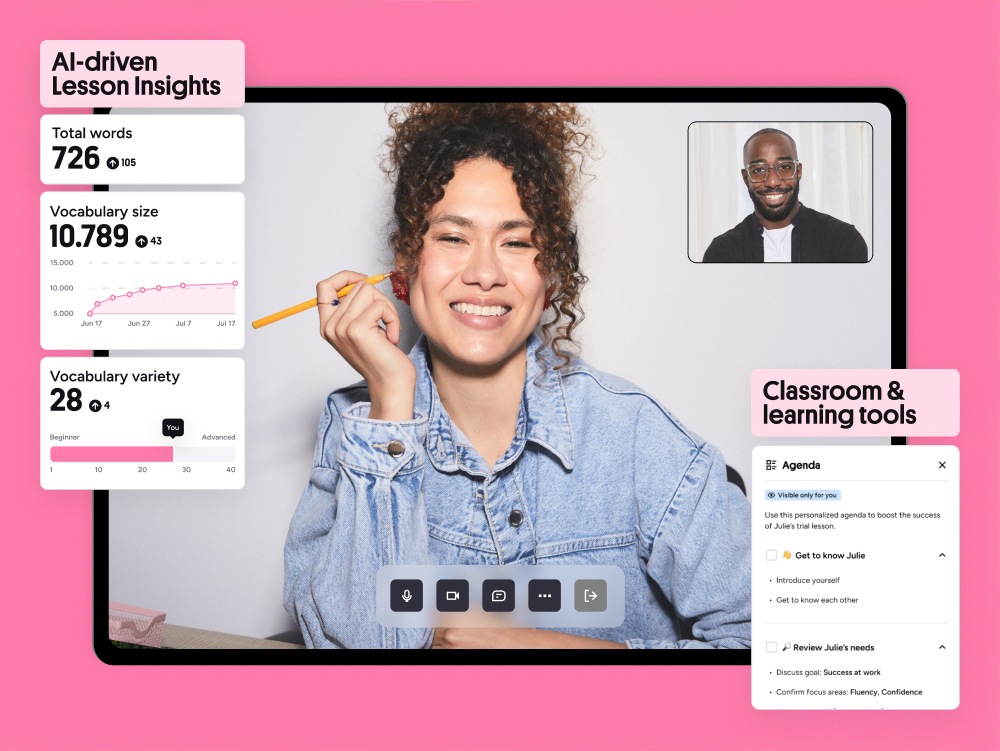
One feature worth using: the "Lesson Notes" section. After each lesson, tutors can write a summary of what was covered, vocabulary introduced, homework assigned, and areas to review. Not all tutors use it consistently. Ask your tutor to fill it out if they don't automatically. It creates a searchable record of your progress and makes it easier to review before the next session. You can also add your own notes during or after the lesson.
Progress Tracking and Lesson Materials
Preply's native progress tracking is minimal — a graph of hours completed and a self-assessment slider. For serious learners, external tracking works better. A simple spreadsheet with columns for date, tutor, topics covered, new vocabulary, grammar points, homework, and self-rating (1–5) gives you a clearer picture over time. Some tutors provide their own progress reports monthly or per package. If this matters to you, ask during the trial whether they offer structured progress updates.
Materials vary widely. Some tutors use a single textbook systematically (e.g., "Greek for You," "Communicate in Greek," "Ellinika Tora"). Others create custom slides, PDFs, and exercises. Many mix resources: a textbook for structure, authentic materials (news articles, songs, videos) for listening, and custom exercises for weak points. There's no single best approach — it depends on your learning style. If you prefer structure, ask for a tutor who follows a curriculum. If you want flexibility, look for someone who adapts materials to your interests.
Homework is not enforced by the platform. Some tutors assign it regularly; others leave it optional. If you want accountability, discuss expectations upfront. A typical pattern: 30–60 minutes of homework between weekly lessons — vocabulary review, grammar exercises, writing a short paragraph, or listening to a podcast segment. Consistency matters more than volume. Ten minutes daily beats two hours once a week. The tutor can recommend apps, websites, or physical workbooks for independent practice.
The platform gives you the connection and the classroom. The curriculum, the pace, and the accountability — those are negotiated between you and the tutor. Don't expect Preply to manage your learning for you.
Common Pitfalls and How to Avoid Them
One common mistake is choosing the cheapest tutor and expecting rapid progress. Low rates often correlate with less experience, no formal training, or high turnover. You may spend months relearning basics because the foundation was shaky. Another pitfall is booking a package with a tutor you've only had one trial with. Take at least two or three paid lessons before committing to 10 or 20 hours. The trial shows the tutor's best behavior; the second and third lessons reveal their consistency.
Some students treat lessons as the only study time. One hour a week with zero practice between sessions leads to very slow progress — you spend half each lesson reviewing what you forgot. Even 10 minutes daily on flashcards, listening, or writing makes a measurable difference. Conversely, overloading — three 90-minute lessons a week plus hours of self-study — often leads to burnout within a month. Sustainable pace beats intensity for language learning.
A Preply-specific issue: tutors occasionally leave the platform or raise rates significantly. If you've bought a large package, you're protected at the old rate until it expires. But if the tutor becomes inactive, Preply will refund unused hours as credits. You can then use those credits with a new tutor. This process works smoothly in most cases, but it disrupts continuity. Keeping packages to 10 hours or fewer limits exposure to this risk.
Comparing Preply to Alternatives for Greek
Preply isn't the only way to find Greek tutors online. Italki is the closest competitor — similar marketplace model, similar price range, slightly different tutor pool. Italki's interface is a bit more utilitarian, but some tutors teach on both platforms. Verbling focuses more on professional teachers with credentials and has fewer hobbyist tutors; rates are generally higher. Tutorful and Wyzant are US-centric and have fewer Greek options. For ancient Greek specifically, the Paideia Institute and individual classicists offer specialized tutoring, often at higher rates than Preply.
If you prefer structured courses over one-on-one tutoring, platforms like GreekPod101, Mango Languages, Duolingo (modern Greek only), and the Center for the Greek Language's online courses provide self-paced curricula. These are cheaper per month but lack personalized feedback and speaking practice. Many learners combine a self-study course for vocabulary and grammar with a weekly Preply tutor for speaking, correction, and accountability. This hybrid approach often yields the best progress per dollar.
University extension courses and local Greek community schools (often run by the Greek Orthodox Church) offer in-person or live online classes. These provide cohort learning, fixed schedules, and sometimes academic credit. They're less flexible than Preply but more structured. Cost per hour is often comparable when you factor in materials and admin fees. If you thrive in a class environment, this is worth checking before committing to private tutoring.
Scroll horizontally to see all columns
| Platform | Best For | Typical Rate | Structure |
|---|---|---|---|
| Preply | Flexible 1-on-1, wide tutor choice | $12–$30/hr | Marketplace, self-directed |
| Italki | Similar to Preply, community features | $10–$28/hr | Marketplace, self-directed |
| Verbling | Credentialed teachers, fewer hobbyists | $20–$45/hr | Marketplace, teacher-focused |
| GreekPod101 / Mango | Self-paced curriculum, low cost | $8–$25/mo | Course-based, no live tutor |
| University / Community | Cohort learning, academic credit | $15–$35/hr equiv. | Fixed schedule, group classes |

For ancient Greek, the alternatives are narrower. The Polis Institute, Ancient Language Institute, and individual scholars offer live online courses. Some university departments run summer intensive programs (e.g., CUNY, UT Austin, Cambridge). These are more expensive and less flexible but provide rigorous academic training. Preply's ancient Greek tutors are a viable option for one-on-one support alongside a course or for independent learners who want guidance through a textbook.
Frequently Asked Questions
How many Greek tutors are typically available on Preply?
At any given time, there are usually 150 to 300 active Greek tutors on Preply, including modern Greek, ancient Greek, and specialized categories. Numbers fluctuate as tutors join or leave the platform.
Can I learn ancient Greek on Preply, or only modern Greek?
Both are available. Filter for tutors listing "Ancient Greek," "Classical Greek," "Koine Greek," or "Biblical Greek" as specialties. These tutors often have academic backgrounds in classics or theology.
What is the average cost of a Greek tutor on Preply?
Most experienced native Greek tutors charge $15 to $30 per hour. Specialized tutors (ancient Greek, exam prep, business) charge $30 to $60+. Newer tutors may charge $8 to $15.
Do I need to buy a package, or can I pay per lesson?
You can pay per lesson at the tutor's standard hourly rate. Packages of 5, 10, 15, or 20 hours offer a small per-hour discount (5–15%) and lock in the rate, but are non-refundable after 30 days.
How does the trial lesson work?
Most tutors offer a 30-minute trial at 50% of their regular rate, or a 50-minute trial at a similar discount. It's a real lesson — level assessment, goal discussion, sample teaching — not just a chat.
Can I switch tutors if the first one isn't a good fit?
Yes. If you've bought a package, unused hours remain as credits in your Preply account and can be used with any other tutor. If you paid per lesson, you simply book with someone else next time.
Does Preply provide textbooks or learning materials?
Preply doesn't provide a standard curriculum. Each tutor chooses their own materials — textbooks, custom PDFs, online resources, or a mix. Ask about materials during the trial lesson.
Is the Preply mobile app good for Greek lessons?
The app works for video calls and chat, but the whiteboard is cramped on a phone. For lessons involving writing (alphabet, grammar exercises), a tablet or desktop is much better.
Final Assessment of Preply Greek Tutors
Preply works well for Greek learners who want flexibility, tutor choice, and the ability to switch if a match isn't right. The platform's tools — search filters, trial lessons, recurring scheduling, and a functional video classroom — reduce friction. The review system, while imperfect, gives enough signal to avoid clearly poor tutors. For modern Greek, the tutor pool is deep enough that most learners can find someone matching their budget, schedule, and learning style within a few trials. For ancient Greek, the pool is smaller but includes qualified classicists and theologians who teach professionally.
The main limitations are structural: Preply doesn't enforce curriculum standards, progress tracking is basic, and the platform takes a significant commission (which tutors factor into their rates). You're responsible for defining your goals, vetting tutors, maintaining consistency, and supplementing with independent study. If you want a guided program with built-in accountability, a course or class may serve you better. If you want personalized, adaptable instruction and are willing to manage the learning process, Preply is a solid option. Start with two or three trial lessons, pick the tutor who makes Greek feel approachable, and commit to a sustainable weekly rhythm. Progress comes from showing up, not from the platform itself.